
TL;DR: In the CBSE vs international school decision, CBSE involves fewer extra steps for a child who will most likely study and work in India, because an Indian Class 12 board result needs no equivalence process. International boards such as the IB and Cambridge are still a valid route. A summary of the UGC's 2025 regulations by an IB and Cambridge school states that 12-year foreign qualifications such as the IB Diploma and A Levels are covered for undergraduate admission in India. Families on the international route add an equivalence application, a grade-conversion step and, for JEE or NEET, a wider gap to the Indian exam pattern. Choose an international board when the plan clearly points to university abroad, and choose CBSE when JEE, NEET, CLAT or CUET are realistic options.
CBSE, IB and IGCSE are separate boards, and "international" is only a label
CBSE is the Central Board of Secondary Education, India's national school board, which sets the Class 10 and Class 12 board examinations. CBSE schools teach from textbooks published by NCERT, the National Council of Educational Research and Training. The IB is the International Baccalaureate, which describes itself as a non-profit foundation registered in Switzerland and runs four programmes from early childhood to the end of school.
Worldwide, the IB says it serves more than 1.95 million students aged 3 to 19 across four programmes, as of August 2026, according to the . The figure is global; the IB's facts page gives no Indian count.
The same IB page reports that the number of IB programmes worldwide grew 34.2% between 2020 and 2024. IGCSE is the International General Certificate of Secondary Education, the Upper Secondary qualification in the Cambridge pathway. Cambridge International describes that pathway as running from age 3 to 19, with Upper Secondary from age 14 and AS & A Level from age 16. Cambridge lists more than 70 IGCSE subjects and more than 50 AS & A Level subjects board-wide, though any one school offers only a selection.
"International" in a school's name is not a guarantee of curriculum or accreditation. In 2011, The International Educator reported that the International Association of School Librarianship found defining an international school "almost impossible" and proposed eight criteria, including an international curriculum and international accreditation. ISC Research, a firm that tracks the sector, has historically used a broad, English-medium definition. Ask every school which board it follows at each grade before you compare anything else.
Families choose within a large private market. One research firm, The Report Cube, values India's school market at USD 59.29 billion in 2025 and puts private unaided schools at about 48% of it by value. The Report Cube's figures are a commercial estimate and give no split by board.
How syllabus, assessment and workload differ across the boards
The core difference between CBSE and an international board lies in how a child is assessed, not in how hard the child works. CBSE Class 12 students study five subjects following the NCERT syllabus, while A Level students usually take three or four, according to sortmyprep, which sells A Level preparation. The IB describes its Diploma curriculum as six subject groups plus a core of theory of knowledge (TOK), creativity, activity, service (CAS) and an extended essay, open only at schools the IB has authorised.
| What you compare | CBSE | Cambridge (IGCSE, then AS & A Level) | IB Diploma Programme |
|---|---|---|---|
| Who sets the syllabus | CBSE, with NCERT textbooks | Cambridge International | International Baccalaureate |
| Subjects in the final two years | Five | Usually three or four | Six subject groups |
| Work beyond subjects | Not a separate core | Not a separate core | TOK, CAS and extended essay |
| Result at the end of school | Indian Class 12 marks card | A Level grades | IB Diploma |
| Extra step for Indian admission | None | Equivalence and grade conversion | Equivalence and grade conversion |
CBSE runs a structured syllabus, strong in mathematics and science, with high-stakes board exams at Class 10 and Class 12. IB assessment mixes final exams with coursework such as the extended essay, so a Diploma student spends more time on research and writing. Neither approach is "deeper"; each suits a different kind of learner.
For a Grade 5 or Grade 6 child, the curriculum gap stays small. The decision starts to bite at Grade 9, when IGCSE begins, and at Grade 11, when the senior qualification decides entrance-exam eligibility.
If my child may take JEE or NEET, is an IB or IGCSE school a risky choice?
An IB or IGCSE school does not bar a child from JEE or NEET, but the road is longer and carries checks a CBSE student never faces. The National Testing Agency hosts free content lectures for JEE Main and NEET-UG and states there is no guarantee that exam questions will come from that content. NTA's lecture page names no school board. The idea that JEE and NEET "follow CBSE" comes from schools and advisers, not from an official NTA statement.
The advisers mostly agree on one point. JBCN International School, which offers IGCSE, writes that IGCSE and A Level build strong conceptual understanding while CBSE aligns more closely with the JEE syllabus pattern. No published data shows that students from any board score higher in JEE or NEET.
An international-board student reaches JEE or NEET in four steps:
Complete a Class 12-level qualification. JBCN International School notes that IGCSE is a Grade 9 and 10 qualification and is not a Class 12 equivalent on its own. The child must continue to AS & A Level or the IB Diploma.
Carry the right senior subjects. The same school states that JEE requires Physics, Chemistry and Mathematics at senior level, and NEET requires Physics, Chemistry and Biology. Confirm the full criteria in the current NTA information bulletin.
Secure equivalence and check board-performance rules. sortmyprep notes that admission to IITs and NITs also applies Class 12 board-performance criteria. Check how JoSAA applies these to a foreign-board result.
Close the exam-pattern gap. JBCN International School says most JEE and NEET aspirants take parallel coaching whatever their board. No published figure measures how many do.
Medical aspirants need one more check. A summary of the UGC's 2025 framework states that professional qualifications such as medicine and law stay under their own statutory councils, so families should also confirm National Medical Commission requirements.
Indian universities accept IB and Cambridge results through equivalence, with extra steps
The Association of Indian Universities states that its Evaluation Division holds the power of according academic equivalence to qualifications from accredited foreign boards and universities. The AIU issues equivalence certificates for students who complete school-level examinations through foreign boards and accepts applications online only.
- Equivalence certificate
- an official confirmation that a foreign-board school qualification counts as completing Class 12 from an Indian board.
The authority is shifting. According to the same summary of the UGC's 2025 regulations, the University Grants Commission notified new rules on 4 April 2025 that make the UGC, rather than the AIU, the body granting equivalence to foreign qualifications for higher education. That summary describes the area as in transition, and some universities still reference AIU processes. Under the UGC framework, decisions typically arrive within 15 working days of complete documents, and a rejected applicant may seek one review within 30 working days.
Equivalence is not admission. sortmyprep notes that the certificate does not secure a seat and that many universities require it, especially for medicine and other professional courses. The same provider reports no single formula for converting A Level grades to percentages, so each university applies its own method. Confirm the current process with the UGC and with each university on your child's list.
Overseas universities set their own rules for Indian-board applicants, so check the international admissions page of each university your child may target.
What does a CBSE school offer that an international school does not?
A CBSE school removes the conversion layer between your child's Class 12 result and Indian admissions. For a family unsure where the child will study, that keeps the most Indian routes open at the lowest administrative cost.
One qualification, no conversion. A CBSE student finishes with an Indian board result, so no equivalence application or grade conversion stands between the child and an Indian university. That saves time in the months when applications cluster.
A closer fit with the entrance-exam pattern. International schools themselves acknowledge the closer JEE alignment. The child prepares for board exams and entrance exams from the same textbooks.
Lower fees. Even C.P. Goenka International School, which runs IB and IGCSE schools, wrote in November 2023 that Cambridge IGCSE schools generally carry higher fees than CBSE and ICSE schools. No published source compares the two in rupees.
If ICSE is also on your list, read CBSE or ICSE: which board suits your child before you shortlist.
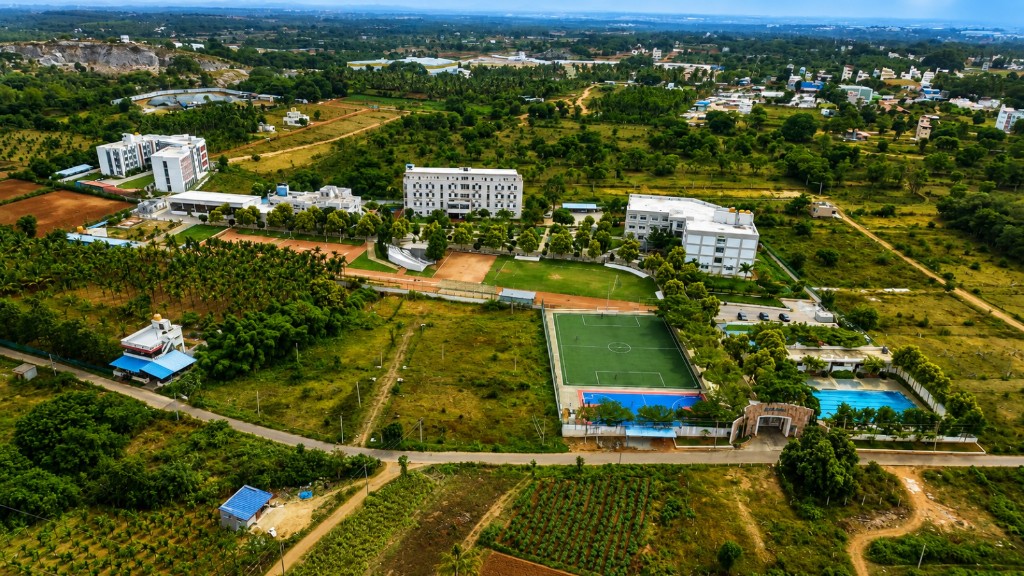
The Academic City School (TACS) in Nelamangala, Bengaluru, is one example of a CBSE boarding school built around career orientation. TACS is fully residential for Grades 5 to 12, follows the CBSE curriculum with NCERT textbooks from Grade 5 to Grade 10, and keeps a 1:10 student-teacher ratio. Every student has an academic mentor and a Student Progression Plan (SPP), reviewed each term and shared with parents, so you track subject improvement term by term. From Grade 6, students explore 600+ career options through psychometric assessments, industry workshops and expert mentoring.
For Grade 11, TACS runs its School Integrated Programme: stream plus board prep plus competitive exam support, structured from Day 1 of Grade 11. NEET preparation forms part of that residential routine, with ALLEN providing academic assistance.
The hidden cost of switching boards later
A child who moves from IGCSE to an Indian board at Grade 11 meets a new syllabus and a new exam style in the two years that decide JEE and NEET. A child who stays international through Class 12 carries the equivalence and conversion steps instead. Switching at Grade 9 or earlier costs far less. TACS accepts children moving from other boards, such as ICSE, from Grade 5 to Grade 9.
An international board makes sense when the plan points abroad
Choose an international board when your child's undergraduate plan clearly lies outside India. Cambridge International states that top-ranked universities worldwide recognise its qualifications, and the IB Diploma's research and writing core prepares students for coursework-heavy degrees.
University abroad is the main plan. An IB Diploma or A Levels matches the format many overseas universities expect. Indian admission stays possible through equivalence.
The family expects to relocate. International boards run in many countries, which helps if a parent's IT role moves the family mid-school.
The child thrives on independent research. The extended essay and TOK reward a student who enjoys long projects over timed exams.
The budget allows the higher fees. Plan for the full run to Class 12, not just the entry year.
The trade-off works in both directions. C.P. Goenka International School concedes that the IB "might lack depth in the Indian context" for students planning to stay. Global exposure does not depend on the board: read how global exposure shapes tomorrow's leaders for ways any school builds it.
For a Bengaluru family with a Grade 5 or Grade 6 child and no fixed plan, CBSE keeps JEE, NEET, CLAT and CUET open with no extra steps. Revisit the choice at Grade 9, when your child's strengths and direction are clearer.
Sources
IB Diploma & IGCSE Recognition in India | TRIO World Academy (Ministry of Education (as reported by TRIO World Academy))
Cambridge International Education (Cambridge International Education, 2026-10-30)
What Makes a School International? | The International Educator (TIE Online) (International Association of School Librarianship (via The International Educator), 2011-08-26)
India School Market Size, Share, and Report 2026-2034 (The Report Cube)
Understanding GCE A Level Equivalence in India: AIU Certificate Guide (sortmyprep (describing the International Baccalaureate Diploma), 2026-10-18)
Diploma Programme (DP) - International Baccalaureate® (International Baccalaureate Organization)
National Testing Agency (National Testing Agency)
Can IGCSE Learners Crack JEE and Get Into IIT? The Honest Answer for Mumbai Parents (JBCN International School, 2026-09-22)
Equivalence of Degree | Association of Indian Universities (Association of Indian Universities)
CBSE vs. ICSE vs. IB vs. IGCSE | International education board (C.P. Goenka International School (blog), 2023-11-23)
Frequently asked questions
- Can my child switch from IGCSE to CBSE midway?
- A child can switch from IGCSE to CBSE, and switching at Grade 9 or earlier costs least. A move at Grade 11 forces the child to learn a new syllabus and exam style during the two years that decide JEE and NEET. Plan any board switch before Class 10 where possible, and confirm entry rules with the new school.
- Are international schools more expensive than CBSE schools in India?
- International schools in India generally charge higher fees than CBSE schools. C.P. Goenka International School, which runs IB and IGCSE schools, acknowledged in 2023 that IGCSE schools generally carry higher fees than CBSE and ICSE schools. No published source compares international and CBSE school fees in rupees, so ask each school for its full fee schedule to Class 12.
- Can a CBSE student study abroad or build a career abroad later?
- A CBSE student can apply to universities abroad and build a career overseas. Each overseas university sets its own entry rules for Indian-board applicants, and some ask for extra tests or documents. Check the international admissions page of every target university by Grade 10, so your child has time to meet any added requirement.
- Can an IGCSE student write JEE or NEET?
- An IGCSE student can write JEE or NEET only after completing a Class 12-level qualification, such as AS & A Level or the IB Diploma, with the right subjects. JEE needs Physics, Chemistry and Mathematics; NEET needs Physics, Chemistry and Biology. Families should confirm current eligibility in the official NTA information bulletin each year.
- Do Indian universities accept the IB Diploma?
- Indian universities accept the IB Diploma through an equivalence process. A school summary of the UGC's 2025 regulations states that 12-year foreign qualifications such as the IB Diploma and A Levels are covered for undergraduate admission. The equivalence certificate does not secure a seat, and each university applies its own grade-conversion method.
- Is an international school better than a CBSE school?
- An international school is better only when the child's plan points clearly to university abroad. For a child likely to study and work in India, CBSE avoids equivalence and grade conversion and aligns more closely with the JEE pattern, as even IGCSE schools acknowledge. Neither board guarantees results; the child's effort and support matter more.
- How do I check whether a school is really an IB school?
- An IB school must hold authorisation from the International Baccalaureate to run its programmes, including the Diploma Programme. The word "international" in a school's name guarantees neither curriculum nor accreditation. Ask the school which board it follows at each grade, and verify IB status in the IB's own school directory before you pay any fee.
Visit TACS before you finalise your child's board
If your shortlist is a nearby international day school and a CBSE boarding school, see how The Academic City School pairs a CBSE foundation from Grade 5 with career orientation from Grade 6. Admissions are open for 2027 to 28, and the whole process can be done online. Book a campus visit or speak to the admissions team about your child's entry grade.