TL;DR: Neither CBSE nor ICSE is the better board for every child, and the right choice depends on how your child learns, where your family may live and what your child may study after Class 10. CBSE follows a uniform, NCERT-based national syllabus that school guides describe as closely aligned with JEE and NEET. Commentators describe ICSE as broader and more English-heavy, with more weight on descriptive answers and project work. A parent guide by Learnify that reviewed the boards' own publications found no board document claiming that one board is better than another[1]. If your child will move from ICSE to CBSE, make the move before Class 9 begins, because CBSE runs Classes 9 and 10 as one two-year course.
Neither board is better: the right choice depends on your child
Parents of children in Grades 5 to 9 often ask which board wins, and the honest answer is that neither does. The parenting channel The Curious Parent put it plainly in February 2026: no board is "better", and the real question is what suits your child[2]. Learnify's guide reached the same conclusion and advised parents to choose by the child's likely next step and the schools open to them. Its author could not open the CISCE website, so that review covers ICSE documents only in part.
The board still shapes daily school life. It decides which textbooks your child reads, how teachers mark answers and how closely the syllabus tracks India's national entrance exams. School quality, however, can count for just as much. In a 2025 interview, Syed Sultan Ahmed, chairperson of TAISI, said CBSE is strong on policy but that execution varies dramatically from school to school[3], and a strong school on either board serves a child better than a weak one.
What is the difference between CBSE and ICSE?
The Central Board of Secondary Education (CBSE) is India's national school board, and it prescribes NCERT textbooks across grades. Every CBSE school in India follows the same NCERT-developed curriculum, so a child who changes cities meets familiar books and the same board exams.
ICSE (Indian Certificate of Secondary Education) is the Class 10 examination of the Council for the Indian School Certificate Examinations (CISCE), a private council that also conducts the ISC examination at Class 12. CISCE prescribes a syllabus but lets each school choose its own textbooks, so two ICSE schools may teach the same chapter from different books. Both boards hold board exams at the end of Class 10 and Class 12.
| Area | CBSE | ICSE |
|---|---|---|
| Who runs it | Central Board of Secondary Education, the national board | CISCE, a private council |
| Textbooks | NCERT textbooks prescribed | Syllabus prescribed; each school chooses its textbooks |
| Syllabus | Uniform across CBSE schools in India, with a strong maths and science focus | Broader; commentators describe it as covering more topics |
| Medium of instruction | English or Hindi, with some schools offering regional or bilingual teaching | English |
| Language emphasis | Third language compulsory in Class 9 from 2026-27 | Commentators describe a stronger focus on language development and structured reading |
| Assessment style | A mix of question types, with a growing share of competency-based questions | Leans on descriptive answers, project work and internal assessment |
| Board exams | End of Class 10 and Class 12 | ICSE at Class 10, ISC at Class 12 |
| Where the detailed rules sit | CBSE's own published rules | CISCE's regulations for each exam year |
The ICSE column rests on secondary descriptions, and sources even disagree on which board offers more subject choice, so check the elective list of each school you shortlist. CISCE sets out its subject rules and internal assessment in regulations for each exam year[4], and any ICSE school can show you the current version.
Assessment is where CBSE and ICSE feel most different
A child feels the gap between the boards most sharply in the way examiners mark answers. School guides describe ICSE as relying more on descriptive answers, project work and internal assessment[5] than CBSE does. That style rewards a child who writes well and works steadily through the year. CBSE papers mix question types, and the board has added competency-based questions in recent years, though some school commentators say repeated practice still drives much of CBSE exam success.
In most major CBSE subjects, 80 marks come from the board exam and 20 from internal assessment, and a student needs at least 33% in a subject to pass, according to .
Grades surprise many parents. In Class 10 and Class 12 board exams, CBSE awards grades by rank: in subjects where more than 500 candidates pass, each grade from A1 to D2 goes to one-eighth of passed candidates. The fixed bands quoted widely online, with A1 for 91 to 100, apply to school-level assessment in Class 9 and Class 11.
The Class 10 calendar has changed as well. From 2026, CBSE Class 10 students sit a compulsory board exam in February-March and may take an optional second exam in May to improve up to three subjects. Learnify reports this without naming the CBSE circular, so confirm the current rules with your child's school. This guide gives no ICSE pass mark, grading scale or improvement-exam rule, because no reliable source for them was available; an ICSE school can show you CISCE's current regulations.
Neither board owns rote learning. Commentators note that both boards are revising assessments under NEP guidelines, with ICSE moving towards competency-based, analytical questions[6]. Whether a child memorises or understands depends far more on the teaching in the classroom than on the name of the board.
Which board prepares a child better for JEE, NEET and other entrance exams?
CBSE has the closer syllabus match with India's national entrance exams, but no published data shows that CBSE students score higher in them. Schools that teach CBSE say the board's syllabus is closely aligned with JEE, NEET and CUET, especially in physics, chemistry and mathematics[7], and other school guides agree that these exams follow NCERT-based frameworks. That overlap spares a CBSE student a second, parallel study plan later, but it describes a mechanism rather than a result: none of the sources behind this guide compares entrance-exam performance by board.
ICSE schools, for their part, position their board as stronger preparation for law, arts, commerce, media and global education. That claim also arrives without admissions data, so read it as a description of emphasis rather than a promise.
Can my child switch from ICSE to CBSE in middle school?
Yes, and middle school is the most workable window for the move. Schools that handle these transfers say a move in Classes 1 to 8 is the smoothest, with Class 9 the last comfortable entry point before board preparation begins[8]. The reason is structural: CBSE runs Classes 9 and 10 as one composite course, so the subjects a child picks in Class 9 carry straight through to the Class 10 board exam.
- Composite course
- a two-year course, such as CBSE Classes 9 and 10, that a student completes as one unit ending in a board exam.
Class 10 is where sources split. One school group calls a Class 10 move possible with academic readiness, while another reports that transfers into CBSE are usually restricted in the board-exam years of Class 10 and Class 12[9]. Neither cites the CBSE rule, so plan the move for Class 9 at the latest and do not count on a Class 10 seat.
A new rule adds weight to early timing. From 2026-27, CBSE Class 9 students must take a third language, assessed in school, and pass it to receive the Class 10 certificate[10]. A child who joins CBSE in Class 6, 7 or 8 has more time to prepare for that language before it counts.
Take these five steps before and after the move
Check the school's affiliation. Ask the school for its CBSE affiliation number and verify it on the official CBSE website before you apply. A school that follows the CBSE syllabus is not always officially affiliated.
Compare the two syllabi for your child's grade. Maths, Science and second languages differ most between ICSE and CBSE. Cover the gaps with NCERT textbooks during the holidays before the new session begins.
Gather the documents early. Schools typically ask for a transfer certificate, recent report cards, a birth certificate, Aadhaar and address proof. Some also require a migration certificate, while others ask for it only from Class 11, so confirm the list with the admitting school.
Prepare your child for a new answer style. Children moving from ICSE often need time to adjust to CBSE's answer format and marking pattern. Practise with sample papers in the first term and ask teachers for feedback on presentation.
Make it the only switch. Each move means a new syllabus and a new assessment style, and schools caution against switching boards repeatedly[11]. Decide once, with the senior years in view.
Be clear about what the evidence does not show. No published study tracks how children who switch boards in Classes 6 to 8 perform afterwards, and every piece of transfer guidance here comes from schools rather than research. Moves in the other direction, from CBSE to ICSE, fall outside the sources behind this guide.
Decide in four steps, before Class 9 begins
Name your child's likely next step. Even a loose direction helps. A steady pull towards engineering or medicine points to CBSE's NCERT base, and our guide on CBSE vs State syllabus for NEET preparation covers that path in detail. Where the pull runs towards languages, writing or the humanities, ICSE's emphasis deserves a serious look.
Read how your child learns. One CBSE school's guidance is that children who thrive on structure, clarity and result-oriented preparation may suit CBSE[12], while those who prefer creativity and depth may suit ICSE. ICSE tests through English, so a child still building confidence in written English can find its descriptive answers and project write-ups steep. Study last year's answer scripts and teacher remarks before you judge.
Factor in where you will live. CBSE is more widely available and uniform across India, which is why families who expect to move cities often prefer it. A residential school offers another answer, because the child's school stays the same even when the family moves.
Judge the school, not only the board. Visit on a working day, sit in on a class and ask how teachers track each child's progress. Then make the choice once, before Class 9 begins.
How The Academic City School approaches the CBSE middle years
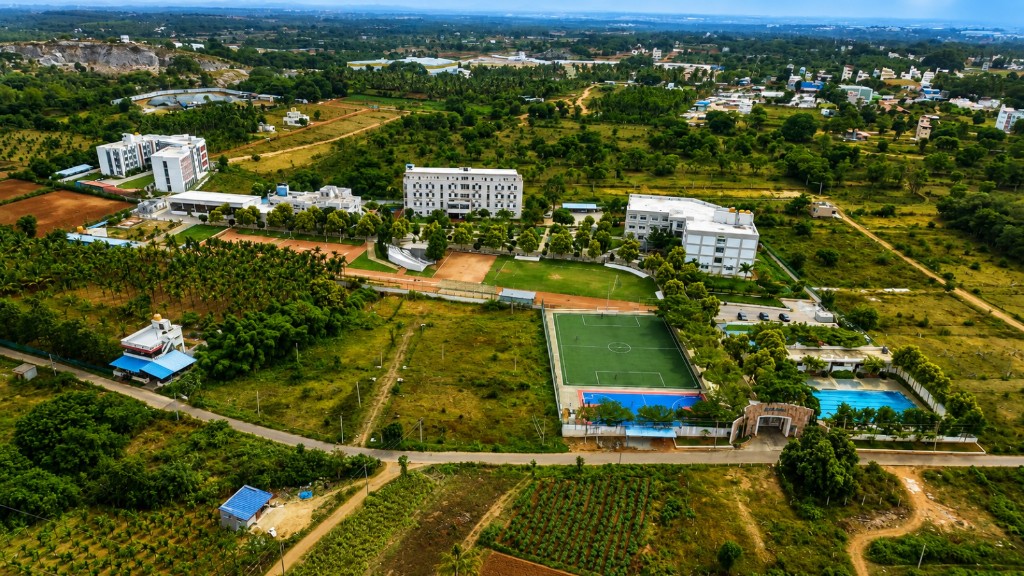
The Academic City School is a residential school that follows the CBSE curriculum, with NCERT textbooks, for Grades 5 to 10 on its Bangalore campus. Teaching runs at a 1:10 student-teacher ratio, the school reports, and every child has a Student Progression Plan. A Student Progression Plan is The Academic City School's individual academic plan for each child, giving the child independent attention so that the child moves at the right pace and understands each concept clearly.
The school also reports that students explore over 600 career options through industry workshops and psychometric assessments from Grade 6 onwards, which gives parents firmer evidence for the first step above. Parents moving a child from ICSE should ask the admissions team which grades are open for entry and how the school plans the first term around the syllabus differences.
Frequently asked questions about CBSE and ICSE
Frequently asked questions
- Which is better, CBSE or ICSE?
- Neither CBSE nor ICSE is better for every child. CBSE suits children who like structure and may aim for JEE or NEET, because its NCERT syllabus overlaps with those exams. ICSE suits strong readers and writers who enjoy depth and language work. The quality of the individual school often matters as much as the choice of board.
- What is the difference between CBSE and ICSE?
- CBSE is India's national board and prescribes NCERT textbooks, while ICSE is the Class 10 examination of CISCE, a private council that lets schools choose their textbooks. Commentators describe ICSE as broader and more English-heavy, with more descriptive answers and project work. CBSE keeps one uniform syllabus across its schools in India.
- Can my child switch from ICSE to CBSE in middle school?
- Yes, a child can usually switch from ICSE to CBSE in middle school, and schools describe Classes 1 to 8 as the smoothest window. Class 9 is the last comfortable entry point, because CBSE treats Classes 9 and 10 as one course. Schools often restrict moves in Class 10, so confirm with the admitting school.
- Is ICSE harder than CBSE?
- ICSE generally counts as the more demanding syllabus because it covers more topics and expects detailed, well-written answers, according to schools and commentators. That view rests on opinion rather than score data, and no published figure compares difficulty across the two boards. A child with strong written English is best placed to meet the ICSE demand.
- Is CBSE better for NEET and JEE?
- CBSE has the closer syllabus match for NEET and JEE, because both entrance exams follow NCERT-based frameworks that CBSE schools teach from. No published data shows that CBSE students actually score higher in these exams. The CBSE overlap reduces parallel study, but daily teaching and steady practice still decide how well a child prepares.
- What documents do I need to move my child from ICSE to CBSE?
- A move from ICSE to CBSE usually needs a transfer certificate, recent report cards, a birth certificate, an Aadhaar card and address proof. Some CBSE schools also ask for a migration certificate, while others need one only from Class 11. Confirm the full document list with the CBSE school admitting your child before you apply.
- What is the CBSE pass mark in Class 10?
- The CBSE pass mark in Class 10 is at least 33% in each subject. In most major CBSE subjects, 80 marks come from the board exam and 20 from internal assessment. From 2026, CBSE Class 10 students can also take an optional second board exam in May to improve up to three subjects.
Sources
- CBSE vs ICSE vs IGCSE: A Parent's Guide for Bahrain (2026) Learnify (Bahrain) ↩
- What is the Difference between CISCE and CBSE? #thecuriousparent - YouTube The Curious Parent (YouTube channel) ↩
- ICSE Vs CBSE Vs International Board – Which Board Is Best For Your Child? | Syed Sultan Ahmed - YouTube Take A Pause with Varun Duggirala (YouTube podcast); speaker Syed Sultan Ahmed, Chairperson of TAISI ↩
- CBSE vs ICSE vs IGCSE: A Parent's Guide for Bahrain (2026) Learnify (Bahrain) ↩
- ICSE vs CBSE: Which Education Board Is Best for Your Child? - Apeejay School, Mahavir Marg, Jalandhar Apeejay School, Mahavir Marg, Jalandhar ↩
- What is the Difference between CISCE and CBSE? #thecuriousparent - YouTube The Curious Parent (YouTube channel) ↩
- What Should You Know Before Moving Your Child from ICSE or IB to CBSE? - Witty India Witty India (Witty Schools) ↩
- What Should You Know Before Moving Your Child from ICSE or IB to CBSE? - Witty India Witty India (Witty Schools) ↩
- How to Switch from State or ICSE to CBSE in Bangalore – A Parent’s Guide Navkis Educational Centre ↩
- CBSE vs ICSE vs IGCSE: A Parent's Guide for Bahrain (2026) Learnify (Bahrain) ↩
- How to Switch from State or ICSE to CBSE in Bangalore – A Parent’s Guide Navkis Educational Centre ↩
- ICSE vs CBSE: Which Education Board Is Best for Your Child? - Apeejay School, Mahavir Marg, Jalandhar Apeejay School, Mahavir Marg, Jalandhar ↩