


TL;DR: No official body ranks the best CBSE schools in Bangalore, so the best school for your child is the one that passes your own checks and fits your family's daily life. The field is wide: one admissions directory, My School Admission, lists 691 schools in its Bangalore CBSE category[1], a count that shows how many options exist rather than how many schools hold CBSE affiliation. A day school keeps your child at home every evening, while a residential school gives a supervised routine from morning to night and usually costs more. Decide by verifying CBSE affiliation, studying three years of board results, getting safety policies and fees in writing, and timing the real commute before you shortlist.
No official ranking names the best CBSE school in Bangalore
Parents who search for the best CBSE schools in Bangalore find lists, not rankings. The lists that circulate online rarely agree with each other, and none of the guides we reviewed points to an official or independent ranking. Yellow Slate's 2026-27 guide, for example, features 26 Bangalore CBSE schools[2] chosen on parent reviews, academic track record, fee value, infrastructure and facilities, but it publishes no weighting or scoring for those criteria. Other directories highlight a largely different set of names, again with no published method.
Treat every list as a longlist. As a Bangalore school's 2027-28 parent guide puts it, rankings may not reflect a particular child's learning needs, school culture or daily commute. Those three factors decide whether your child settles and grows, and no list can weigh them for you.
- CBSE affiliation
- the formal recognition a school holds from the Central Board of Secondary Education to teach the board's curriculum and prepare students for its board examinations in Classes 10 and 12.
The best CBSE school in Bangalore is the one that passes your checks and suits your child, wherever it sits on a list.
A day school and a residential school give your child two different days
A CBSE day school is a CBSE-affiliated school where children attend classes during school hours and return home every evening. Residential schools, often called boarding schools, are schools where children live on campus during term and study, eat, sleep and play under the school's supervision. Both follow the same CBSE curriculum and prepare students for the same board examinations. They differ in who shapes the hours outside the classroom.
Boarding School Review, a US school directory, describes the general pattern[3]: boarding structures the day from morning through evening and typically costs more, while day schools keep family involvement central and generally cost less. It also notes that boarding schools build evening study halls and tutoring into daily life, whereas day schools rely more on homework done at home with parental support.
| Factor | CBSE day school | CBSE residential school |
|---|---|---|
| Where your child sleeps | At home | On campus, in supervised hostels |
| Daily travel | Two trips a day through city traffic | None on school days |
| Evening study | Homework at home, guided by parents or tuition | Fixed study hours with teachers on campus |
| Supervision after school | Parents and family | House staff and teachers |
| Family involvement | Daily and face to face | Calls, visits and parent meetings |
| Sport and co-curricular time | Mostly after school, limited by travel | Evenings and weekends available |
| Cost | Tuition plus transport | Higher, as fees include boarding and lodging |
| Independence | Grows gradually with family support | Grows faster as children manage their own routines |
Day schools and residential schools teach the same CBSE syllabus; what separates them is who guides a child's evenings.
Boarding is not better than day school, but it suits some children more
No study we reviewed shows that a residential school produces better board results than a day school, or the reverse, and we found no such comparison for Indian CBSE schools. Boarding School Review reaches a balanced conclusion: success depends more on student engagement and school quality[4] than on whether the school is residential or commuter-based. Start from your child, then choose the format.
The same directory says boarding tends to work well for students who seek independence, enjoy structured academic environments and want extensive extracurricular opportunities. It adds that for many younger students, or those strongly tied to family routines, the day-school balance of school plus daily family guidance can be beneficial.
North American research points in a similar direction, with clear limits. One US school cites a report by The Association of Boarding Schools and Canadian Accredited Independent Schools, School Life in Focus: The Boarding Advantage, as finding that boarding students report higher levels of engagement and independence[5]. Both publishers represent boarding and independent schools, the outcomes are self-reported, and the data does not come from India. Read it as a picture of what boarding can build, not as proof that it will.
Use these signals to judge the fit for your own child:
Your child asks for more independence. A child who already manages homework and a timetable without reminders brings the habits a hostel routine depends on. Boarding then turns those habits into daily practice.
Your child is younger or closely tied to home routines. A day school keeps you present every evening, and you can revisit boarding at a later grade. Our guide on what's the right age to send a child to boarding school covers that decision in detail.
Your evenings are stretched. When both parents work long hours or travel often, ask honestly who supervises homework between 4 pm and 9 pm. A residential routine gives those hours a fixed structure and a teacher nearby.
In Bangalore, the daily commute often settles the question
Travel time deserves more weight than any school list gives it. A Bangalore school's parent guide advises checking the actual travel time in traffic[6] and how it affects sleep and after-school activities. None of the guides we reviewed publishes an average commute figure for Bangalore schoolchildren, so measure your own: do a dry run at the real school-run hour, in both directions, before you shortlist.
Take a simple example. A child who spends 75 minutes each way on a school bus spends two and a half hours a day travelling, which adds up to twelve and a half hours across a five-day week. Those hours come out of sleep, homework, play or family meals. For a family living far from a suitable school, that arithmetic alone can make a residential school the practical choice.
A day-school evening depends on who is at home and how tired everyone is after the drive back, while a residential school sets the study hours and has staff supervise them. One US boarding school describes faculty often living on campus and being accessible outside class hours[7]; verify exactly this at any residential school you shortlist by asking who is on duty at night.
Seven checks let you compare any CBSE school fairly
Run every school on your longlist, day or residential, through the same seven checks, and ask for the answers in writing.
Confirm CBSE affiliation on the board's own portal. According to a Bangalore school's admissions guide, CBSE has issued an advisory asking parents to verify affiliation[8] after complaints about schools using phrases such as "CBSE pattern". Search the school by name or affiliation number on CBSE's official affiliation portal, and confirm the status is valid for the current academic year and the grades your child needs.
Ask for three years of board results. The same guide advises requesting Class 10 and Class 12 results across at least three consecutive years and studying the spread of scores rather than the topper alone. One strong batch tells you little about how the school teaches an average student.
Count the students per teacher yourself. That guide also offers a ratio under roughly 25:1[9] as a rule of thumb for individual attention; it is a guideline, not a CBSE norm. Confirm the real number by asking how many students sit in your child's future section, and watch a class during your visit.
Ask for safety policies in writing. A reasonable minimum is staff background checks, CCTV with a clear policy, a counsellor, and documented anti-bullying and emergency procedures. Verbal assurances do not count.
Get the full fee schedule in writing. Ask each school for a full fee breakdown covering tuition, transport, activities and other charges[10], because directory listings often leave fees blank. A higher fee does not guarantee better quality, so compare what each school actually offers for the amount.
Ask how long core teachers stay. Teacher turnover tells you whether a school can keep good staff. Ask how many of the Class 9 and 10 teachers have taught there for three years or more.
Visit on a normal school day. Walk the campus, speak with existing parents and watch an ordinary lesson before you decide. Reviews and ratings help, but a visit with time to talk to teachers gives you a clearer picture.
For a residential school, add four questions: who supervises the hostel at night, how often the school updates parents, what medical support sits on campus, and how weekends run. Yellow Slate's aggregated parent feedback on one Bangalore-area residential school flags communication between campus and parents[11] and senior-grade faculty retention as points to ask about, which makes them good questions for any boarding school.
How The Academic City School shapes a residential CBSE day in Nelamangala
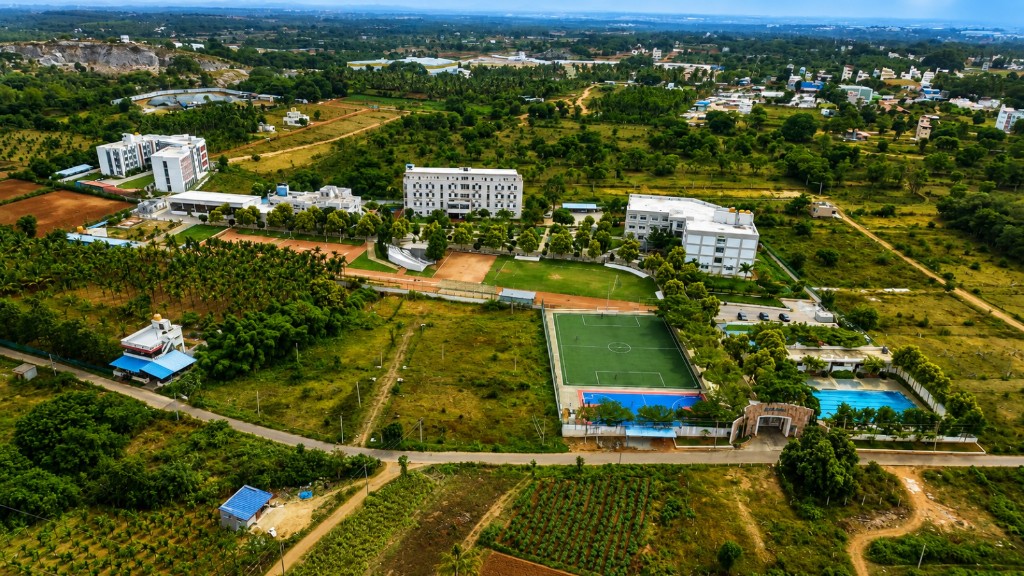
The Academic City School runs a fully residential campus in Nelamangala, in the green countryside near Bangalore, for students from Grade 5 to Grade 12. Students follow the CBSE curriculum with NCERT textbooks from Grade 5 to Grade 10. Each day moves between focused classroom learning, sport, creative work and a home life shaped by Indic values.
Academic attention sits at the centre of the residential day. The Academic City School reports a student-teacher ratio of 1:10 and gives every student a Student Progression Plan from Grade 5. That plan tracks each child's progress subject by subject, so teachers spot a gap early and close it before it grows, which leads to steady academic growth.
Boys and girls live in separate air-conditioned hostels, and the school serves six meals a day with vegetarian and Jain options. Evenings carry supervised study, so homework never depends on how late a parent gets home.
From Grade 11, The Academic City School runs its School Integrated Programme, which brings stream subjects, board preparation and competitive exam support into one structured plan from Day 1 of Grade 11. Students who aim for NEET prepare with ALLEN as academic assistance. The school promises a disciplined routine and close attention, not a rank or a selection.
Apply the same seven checks to The Academic City School that you apply to every other school. Ask the admissions team for the CBSE affiliation details and check them on the portal, request the fee schedule in writing, and visit the Nelamangala campus on a normal school day. Our guide on how to choose the best boarding school in India for your child takes the residential choice further.
Begin admission enquiries early, and earlier still for a boarding seat
Admission timelines vary from school to school, so plan backwards from each school's own calendar. A Bangalore school's 2026-27 guide reports that most CBSE schools in the city open admissions between September and January[12] for the following academic year. Residential seats can need longer: for the residential school it profiles, Yellow Slate advises starting enquiries 12 to 18 months before the intended start date[13].
Schools commonly ask for a birth certificate, previous academic records and identity proof, and a residential school may also ask for a medical fitness certificate. The Academic City School has opened admissions for 2027-28 for Grades 5 to 12 at its Nelamangala campus.
Frequently asked questions
Frequently asked questions
- Which are the best CBSE schools in Bangalore?
- No official ranking names the best CBSE schools in Bangalore. Directories and blogs publish lists, but the lists rarely agree and seldom explain their scoring. Use any list as a longlist, then shortlist CBSE schools in Bangalore by verified affiliation, three years of board results, safety policies, written fees, commute time and your child's needs.
- Is a boarding school better than a day school?
- A boarding school is not automatically better than a day school. No published evidence for Indian CBSE schools shows either format producing better results. Boarding suits children who want independence, structure and more co-curricular time, while a day school suits younger children and families who want to stay closely involved in daily study.
- How do I choose a CBSE school in Bangalore?
- Choose a CBSE school in Bangalore by verifying affiliation on CBSE's official portal first. Then compare three years of board results, the real student-teacher ratio, written safety policies and the full fee schedule. Time the commute at school-run hours, and visit each shortlisted campus on a normal school day before you decide.
- How do I check whether a school is really CBSE-affiliated?
- Check a school's CBSE affiliation on the board's official affiliation portal. Search by school name or affiliation number, and confirm the status is valid for the current academic year and covers the grades your child needs. Ignore advertising phrases such as "CBSE pattern", which do not confirm that a school holds CBSE affiliation.
- Does a residential school cost more than a day school?
- A residential school costs more than a day school because its fees cover boarding, lodging and meals on top of tuition. No reliable published figure compares the two in Bangalore, so ask each school for a written fee schedule and compare exactly what it includes, such as meals, laundry, hostel and weekend activities.
- Can my child switch to a CBSE school from another board?
- A child can switch to a CBSE school from another board in most cases, depending on seat availability and how well the child adapts to the CBSE curriculum. Ask the school which grades accept transfers, what documents it needs, and what support it gives students who join partway through a course.
Sources
- Best CBSE Schools in Bangalore 2026-27 | Fees & Admissions My School Admission (listing blurbs) ↩
- Best CBSE Schools in Bangalore 2026-27: Fees, Reviews & More Yellow Slate - Blog Yellow Slate (school discovery blog) ↩
- Boarding School vs Day School: Key Differences for Families The Association of Boarding Schools (TABS), as cited by Boarding School Review ↩
- Boarding School vs Day School: Key Differences for Families The Association of Boarding Schools (TABS), as cited by Boarding School Review ↩
- Why Boarding at a Day School is Better Than a Traditional Boarding School | Boarding Blog Saint Andrew's School ↩
- How to Choose a CBSE School in Bangalore: 2027–28 Parent Guide Skalvi International School ↩
- 20 Reasons Why Boarding School Is Better Than Day School | Darrow School Darrow School ↩
- Best CBSE School in Bangalore: Key Features to Look For Presidency School Bangalore East ↩
- Best CBSE School in Bangalore: Key Features to Look For Presidency School Bangalore East ↩
- How to Choose the Best CBSE Schools in Bangalore 2026? Vaps Technosoft Pvt Ltd (Vapstech blog) ↩
- Best CBSE Schools in Bangalore 2026-27: Fees, Reviews & More Yellow Slate - Blog Yellow Slate (school discovery blog) ↩
- Best CBSE Schools Bangalore for Academics year 2026-27 Presidency School Bangalore North (school blog) ↩
- Best CBSE Schools in Bangalore 2026-27: Fees, Reviews & More Yellow Slate - Blog Yellow Slate (school discovery blog) ↩