



Every year, right around September, we start getting the same message from worried parents. “My child understands the concept in class, but the moment the question changes shape a little, they freeze.” Honestly, we get it. Maths at the Class 10 level isn’t really about memorising anymore, it’s about pattern recognition under pressure. And that’s exactly the gap NCERT Solutions for Class 10 Maths are built to close.
We’ve put together this guide as a complete study hub, not just another list of answers copied from a textbook. Think of it as chapter-wise solutions, MCQs, important questions, PYQs, and formula sheets, all sitting under one roof so a student (or a slightly panicked parent scrolling at 11pm) doesn’t have to hunt across ten tabs.
Why NCERT Solutions for Class 10 Maths Matter Most
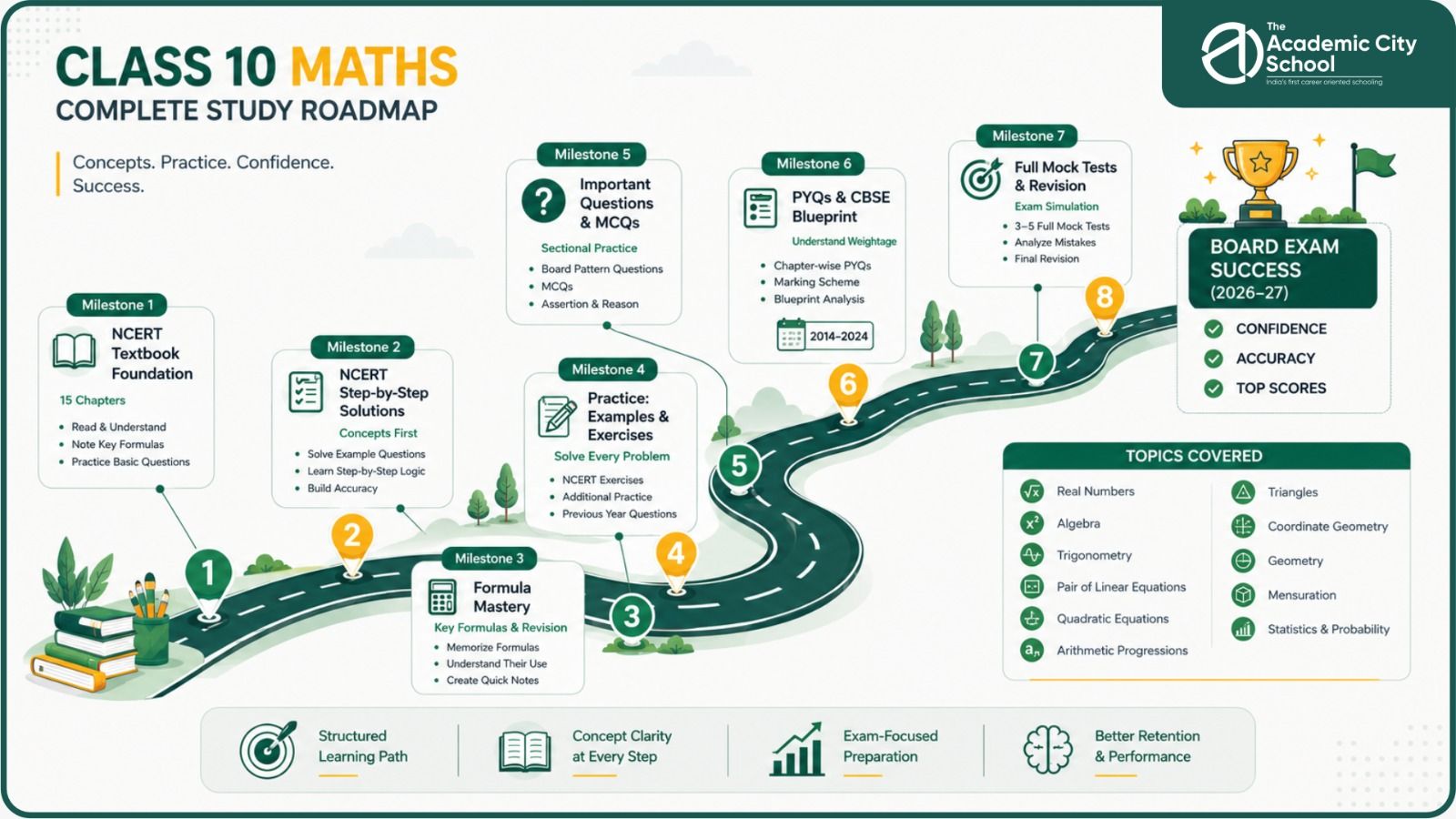 Figure 1: Complete Maths learning roadmap
Here’s the thing nobody tells you early enough: Class 10 Maths is actually one of the most scoring subjects on the entire CBSE board exam. Not because it’s easy, but because it’s predictable. Once you know the pattern, marks come fairly steadily.
Good NCERT Maths Solutions Class 10 material builds several things at once:
- Board exam confidence, since students stop guessing and start recognising question types
- A foundation for competitive exams like JEE and other entrance tests down the line
- Sharper logical thinking, which honestly helps outside maths too
- Numerical accuracy (fewer silly calculation slips under exam pressure)
- Real problem-solving skill, not just formula plugging
- Readiness for higher mathematics in Class 11 and 12
What are NCERT Solutions for Class 10 Maths? In plain terms, they’re chapter-wise, step-by-step solutions prepared strictly according to the latest CBSE syllabus. They help a student understand the “why” behind each step, not just the final answer, while also giving practice through important questions and board-style problems.
We keep coming back to three pillars whenever we design a chapter’s content:
- Concept Clarity, understanding before memorising
- Formula Mastery, knowing when, not just how, to apply a formula
- Regular Practice, because maths rewards repetition more than any other subject
CBSE Class 10 Maths Exam Pattern & Marks Distribution
Let’s get the numbers out of the way first, because strategy without numbers is just guesswork.
| Component | Marks |
|---|---|
| Theory | 80 |
| Internal Assessment | 20 |
| Total | 100 |
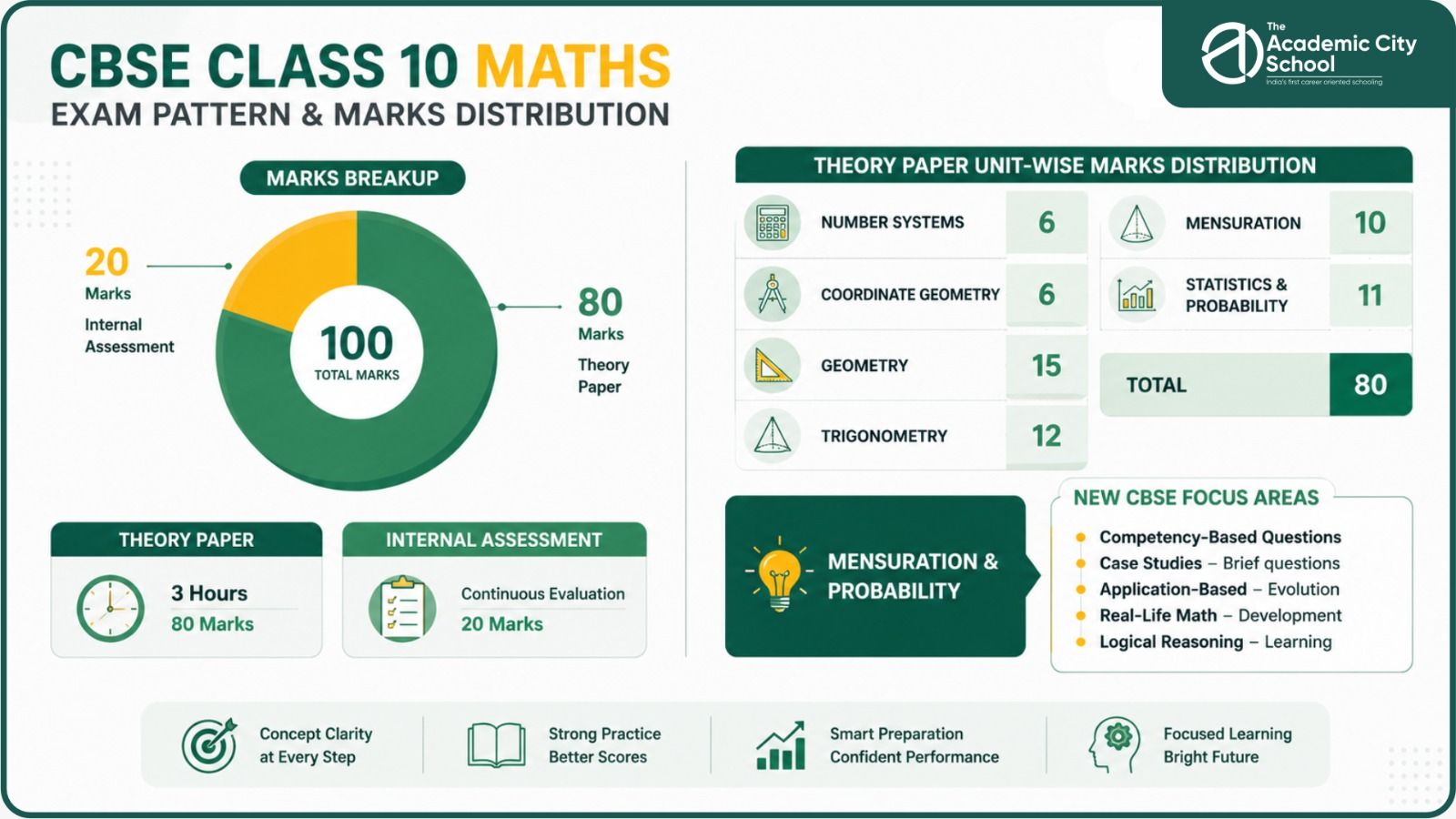 Figure 2: Board exam structure
The theory paper draws from eight broad units: Number Systems, Algebra, Coordinate Geometry, Geometry, Trigonometry, Mensuration, Statistics, and Probability. Some years the weightage shifts slightly, but these eight blocks form the entire skeleton of the syllabus.
There’s also a newer shift worth flagging. CBSE has been steadily increasing focus on:
- Competency-based questions
- Case studies drawn from real situations
- Application-based problems (less “solve this” and more “here’s a scenario, now solve it”)
- Real-life mathematics, tying algebra or trigonometry to everyday contexts
- Logical reasoning embedded within numerical problems
This means rote learning alone won’t cut it anymore. A student needs to actually understand what a quadratic equation represents, not just how to factorise one.
TAC's 4-Tier Mathematics Learning Framework
At The Academic City School, we don’t just hand over solved exercises. We built a four-tier framework because we noticed students plateau when they only get answers without the surrounding scaffolding.
Tier 1: NCERT Step-by-Step Solutions. The base layer. Every exercise question solved with full working, not shortcuts that skip the reasoning.
Tier 2: Concept Visualisation. This is where flowcharts, formula maps, and concept trees come in. A lot of students are visual learners and a well-drawn formula map does more than three re-readings of a textbook paragraph.
Tier 3: Exam Excellence. Important questions, PYQs, MCQs, and HOTS (Higher Order Thinking Skills) questions, layered on top of the basics once concepts are settled.
Tier 4: AI Recall Layer. Quick revision tools, formula cards, active recall prompts, and memory notes designed for the final weeks before boards, when there’s no time left for lengthy re-learning.
Complete Class 10 Maths Resource Hub
Every single chapter on this hub comes packaged with the same set of resources, so nothing feels incomplete halfway through:
- NCERT Exercise Solutions
- Solved Examples
- Formula Sheet
- Important Questions
- MCQs with Answers
- Assertion-Reason Questions
- Competency Questions
- Previous Year Questions (PYQs)
- Common Mistakes section
- Revision Notes
- Downloadable PDFs
Interactive Chapter-Wise NCERT Solutions Directory
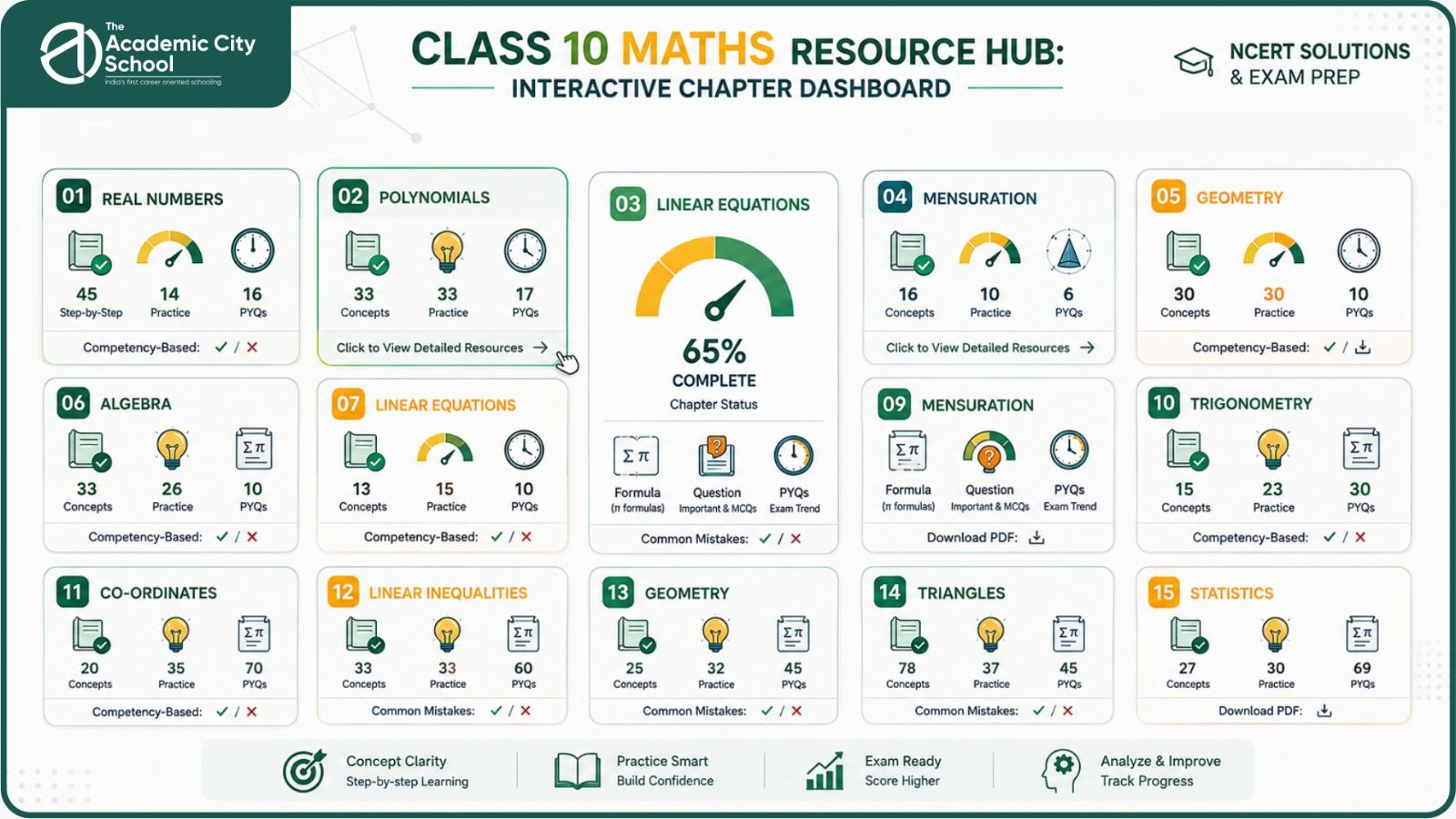 Figure 3: Interactive chapter dashboard
Here’s the full chapter breakdown, grouped by unit, along with what each chapter page includes.
Number Systems
| Chapter | Resources |
|---|---|
| Real Numbers | Solutions + MCQs + PYQs |
Algebra
| Chapter | Resources |
|---|---|
| Polynomials | Solutions + MCQs |
| Pair of Linear Equations in Two Variables | Solutions + Important Questions |
| Quadratic Equations | Solutions + PYQs |
| Arithmetic Progressions | Solutions + MCQs |
Coordinate Geometry
| Chapter | Resources |
|---|---|
| Coordinate Geometry | Solutions + MCQs |
Geometry
| Chapter | Resources |
|---|---|
| Triangles | Solutions + PYQs |
| Circles | Solutions + Important Questions |
| Constructions | Solutions + Practice Sets |
Trigonometry
| Chapter | Resources |
|---|---|
| Introduction to Trigonometry | Solutions + MCQs |
| Applications of Trigonometry | Solutions + PYQs |
Mensuration
| Chapter | Resources |
|---|---|
| Areas Related to Circles | Solutions + Practice |
| Surface Areas and Volumes | Solutions + Important Questions |
Statistics & Probability
| Chapter | Resources |
|---|---|
| Statistics | Solutions + MCQs |
| Probability | Solutions + PYQs |
Formula Mastery & Problem-Solving Guide
Formulas are where most marks quietly slip away, usually not because students don’t know them, but because they blank out under time pressure. A few things genuinely help:
- Daily formula revision, even ten minutes, keeps recall sharp
- Formula flashcards that a student can flip through while waiting for the school bus
- Concept linking, connecting a formula to why it works, not just what it says
- Shortcut recognition, spotting when a longer method can be skipped
Our problem-solving framework follows a simple five-step chain: Understand the question, Plan an approach, Solve it methodically, Verify the answer against the question’s context, and Learn from any mistake made along the way.
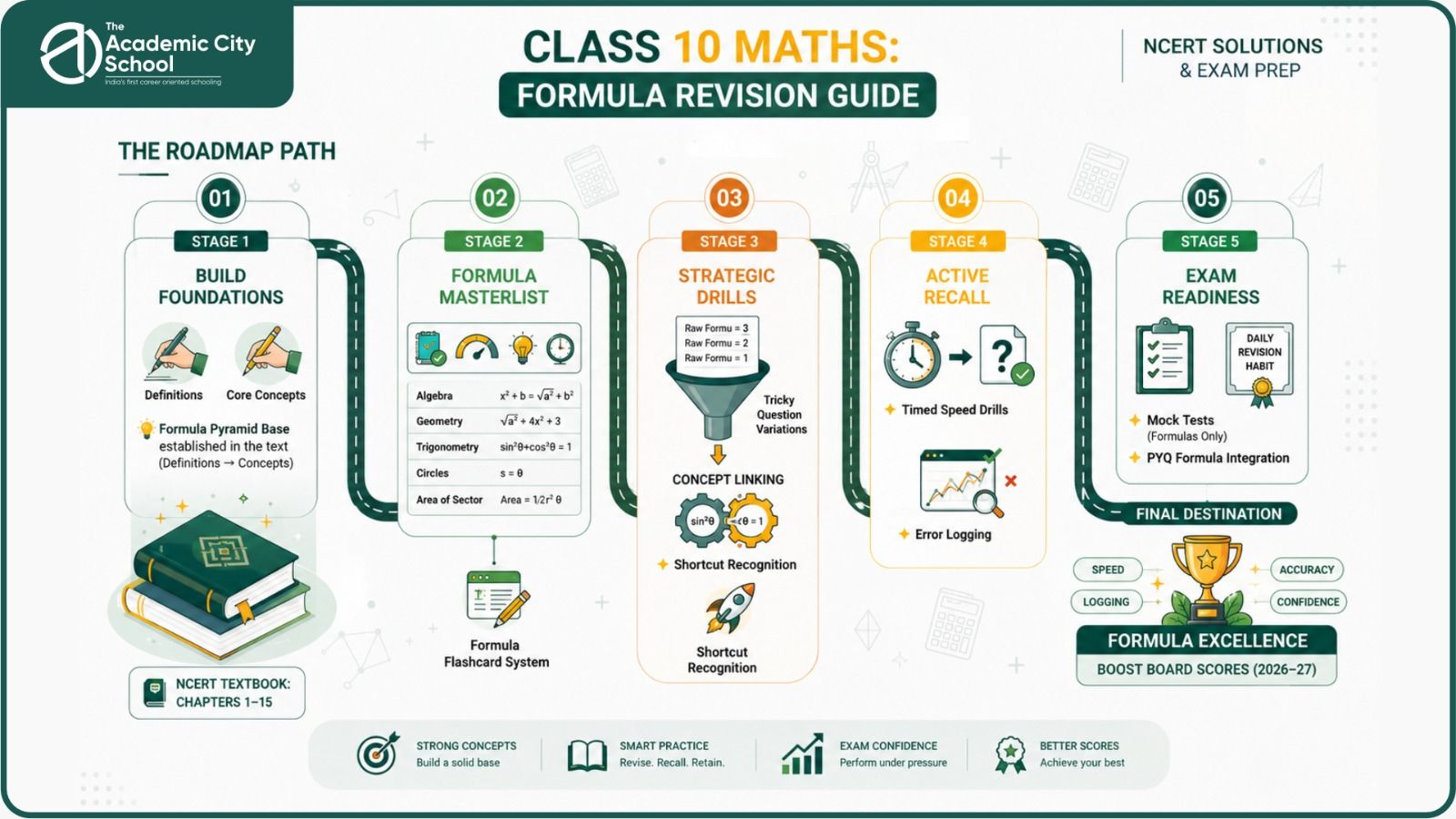 Figure 4: Formula revision roadmap
We also use what we call the Formula Pyramid with students: start from Definitions, build up to Concepts, then Formulas, then Applications, and finally Board Questions. Skipping straight to formulas without the base almost always causes confusion later.
High-Weightage Chapters & Exam Intelligence Dashboard
Not all chapters carry equal exam weight. Based on recurring board patterns, here’s where the marks tend to concentrate.
| Chapter | Board Frequency |
|---|---|
| Quadratic Equations | Very High |
| Trigonometry | Very High |
| Circles | High |
| Surface Areas & Volumes | High |
| Statistics | High |
| Probability | High |
| Triangles | High |
A quick insight from our faculty: most board questions are repeatedly based on NCERT examples, exercises, formulas, and competency-based applications rather than entirely new problem types. So a thorough NCERT run-through genuinely covers most of what shows up.
Important Questions & Competency-Based Practice Hub
This section pulls together the question types most likely to appear beyond the standard exercises:
- Long Answer Questions
- Short Answer Questions
- Competency-Based Questions
- Case Studies
- HOTS (Higher Order Thinking Skills)
- Real-Life Problems
- Formula-Based Questions
Real-world applications students should be comfortable with include banking calculations, architecture and construction measurements, business scenarios, navigation problems, and basic engineering contexts. These show up more often now, especially in the case-study format CBSE has been favouring.
MCQ Practice & Assertion-Reason Question Bank
Class 10 Maths MCQs with Answers deserve focused, timed practice, not casual reading. Our MCQ bank includes:
- Chapter-wise MCQs
- Assertion-Reason Questions
- Match the Following
- Fill in the Blanks
- One-Mark Questions
- Speed Practice Sets
A tip we give every batch: practice MCQs with a timer running. Recognising the right approach quickly matters as much as knowing the right answer.
Previous Year Question (PYQ) Intelligence Center
Class 10 Maths PYQs reveal patterns that raw practice alone won’t show you.
| Chapter | Frequency |
|---|---|
| Trigonometry | Very High |
| Quadratic Equations | Very High |
| Triangles | High |
| Statistics | High |
| Circles | High |
Recurring concepts contribute significantly to board exam questions, which is exactly why consistent NCERT-based practice, paired with regular PYQ solving, tends to be so effective.
Common Mistakes That Cost Marks
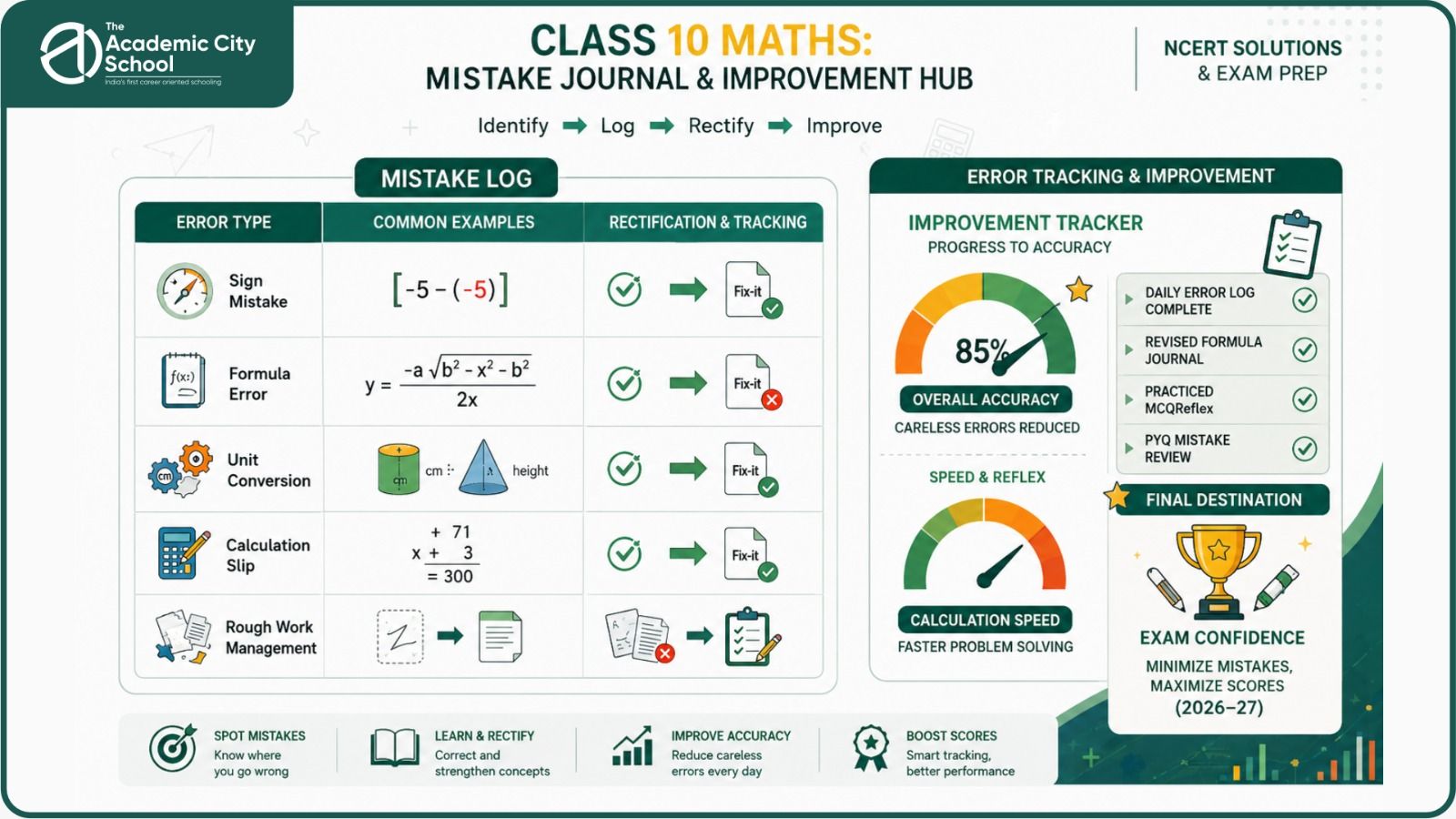 Figure 5: Error tracking and improvement
We’ve reviewed enough answer sheets to notice the same slip-ups repeating year after year:
- Formula errors, using the wrong version of a similar-looking formula
- Sign mistakes, especially in algebra and coordinate geometry
- Calculation errors under time pressure
- Unit conversion mistakes in mensuration questions
- Diagram errors in geometry and trigonometry
- Incomplete steps, losing marks even when the final answer is correct
- Rough work mistakes that carry through to the final solution
As our faculty often puts it, most students lose marks due to careless calculation rather than a genuine lack of understanding. That’s actually good news, because careless mistakes are fixable with practice and attentiveness.
Standard Maths vs Basic Maths Strategy
CBSE offers two Maths papers at Class 10, and the choice matters for future subject combinations.
Standard Mathematics: This path is designed if you want to take PCM or PCB with Core Math in classes 11 and 12. The difficulty is on the higher end, with lots of application-style challenges. You want your strategy to step out and go deeply into best practice problems.
Basic Mathematics: This option is perfect for students heading straight into Humanities or specific Commerce streams without higher math needs. The paper focuses completely on direct formula use and primary exercises. Your key focus is absolute mastery over textbook examples.
| Factor | Standard Maths | Basic Maths |
|---|---|---|
| Difficulty Level | Higher | Moderate |
| Suitable Career Path | Science, Engineering | Commerce, Humanities |
| Recommended Practice | PYQs + HOTS heavy | NCERT + Important Questions focus |
Smart Revision Framework & Memory System
A daily routine that’s worked consistently well for our students looks something like this: 45 minutes on concepts, 45 minutes on practice, and 30 minutes purely on revision. It’s not glamorous, but consistency beats intensity here.
Our revision toolkit usually includes a formula notebook maintained by the student, an error log tracking repeated mistakes, flashcards for quick recall, a stack of solved PYQs, and periodic mock tests to simulate real exam conditions.
Smart 30-Day Maths Revision Blueprint
For students revising closer to the exam, here’s a structure that spreads the syllabus sensibly across a month.
- Days 1 to 5: Number Systems & Algebra
- Days 6 to 10: Coordinate Geometry
- Days 11 to 16: Geometry
- Days 17 to 21: Trigonometry
- Days 22 to 26: Mensuration
- Days 27 to 30: Statistics, Probability & full-length Mock Tests
Free Downloadable Maths Success Toolkit
To make revision genuinely easier, we’ve packaged a downloadable toolkit that includes a formula book, chapter-wise notes, an MCQ bank, a PYQ collection, a competency question bank, a mistake journal, a revision planner, and a mock test planner.
Why Students Choose The Academic City School
What sets TAC apart isn’t just the resources, it’s how they’re delivered. Our approach includes a fully CBSE-aligned curriculum, dedicated Smart Mathematics Labs for concept visualisation, experienced faculty who’ve seen these exact question patterns for years, and personalised mentorship rather than one-size-fits-all coaching.
Students consistently report stronger board scores, better concept clarity, faster problem-solving speed, improved calculation accuracy, genuine exam confidence, and a far more structured revision system than they had before.
Maths doesn’t reward last-minute effort the way some subjects do. It rewards steady, structured practice, and that’s exactly what we’ve tried to build into this resource hub, chapter by chapter, question by question.
Frequently Asked Questions
Are NCERT Solutions enough for Class 10 Maths?
Yes, absolutely. They cover every square inch of the official CBSE layout. If you know every example and exercise inside out, you are set for top marks.
Which chapters carry the highest weightage?
Quadratic Equations, Trigonometry, Circles, Surface areas & Volumes, Statistics and Probability have been consistently scoring high marks in recent board papers.
How many MCQs should I practice daily?
Stick to 5 to 10 mixed questions daily. It keeps your basic conceptual properties sharp without burning through your energy.
Are competency-based questions important?
Yes, CBSE has been steadily increasing their share, and they test understanding rather than memorisation, so regular exposure to this format genuinely helps.
How should I revise formulas?
Little and often works better than long cramming sessions. Ten minutes of daily formula revision, paired with flashcards, tends to stick far longer.
How often should I solve PYQs?
At least once a week during regular study, increasing to almost daily in the final month before boards.