




Exam season has a funny way of sneaking up on people. One week you're calmly doing your homework, and then, almost overnight, someone mentions the board exam date and your stomach does a little flip. Sound familiar? It happens to nearly every Class 10 student, and honestly, it happened to most of us too, back when we were sitting where you are now. So here is what we did. We sat down and pulled together every single formula from the CBSE Class 10 Maths syllabus, organised chapter by chapter, written in plain language, with the actual formula written out clearly so you are not squinting at some cramped textbook footnote three days before your paper. No fluff. No filler. Just formulas, explained the way we would explain them in a TAC classroom.
Why Every Class 10 Student Needs a Formula Sheet
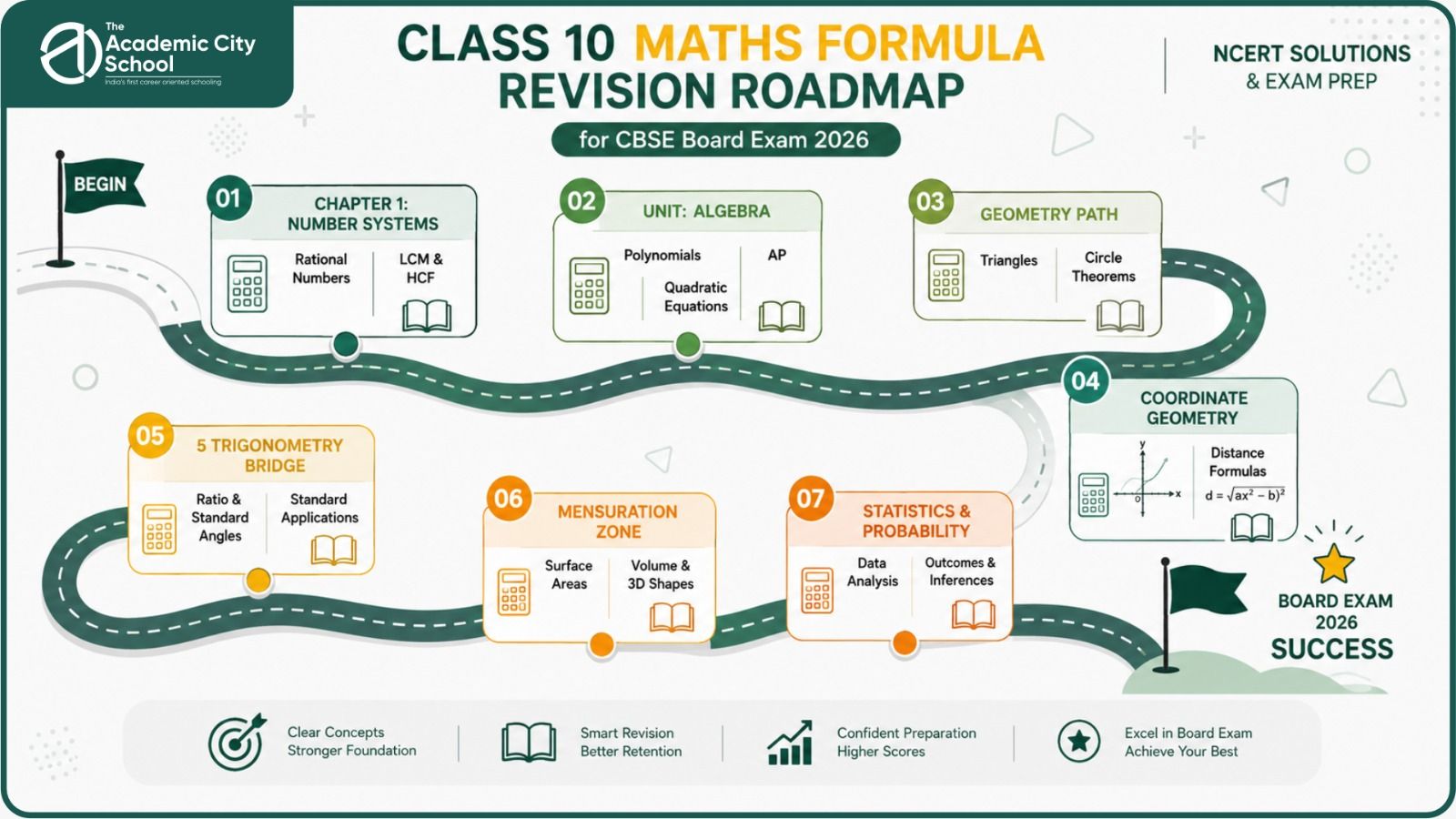 Figure 1: Complete formula learning journey
Maths is not the kind of subject you can cram the night before, not really, not if you want to actually solve anything. But formulas? Those behave a little differently. They are compact, they are specific, and if you organise them well, you can genuinely refresh your memory on an entire chapter in ten or fifteen minutes flat.
What is a Class 10 Maths Formula Sheet?
A Class 10 Maths Formula Sheet is a chapter-wise collection of all essential mathematical formulas prescribed in the latest CBSE syllabus. It helps students revise quickly, improve problem-solving speed, and perform better in board examinations.
Quick Answer: A well-organised formula sheet helps you study faster, lock in equations longer, crack problems smoothly, drop careless errors, feel way more ready, and save priceless study time right before the final exam.
Benefits of Formula Revision
- Better memory retention. Formulas grouped by chapter genuinely stick better than notes scattered across five different notebooks
- Faster question solving, because the formula is right there on the tip of your tongue instead of buried somewhere in your memory
- Improved accuracy. Fewer silly slips, fewer "oh no, I used the wrong sign" moments mid-exam
- Stronger concept recall, sometimes even months after you first learned the chapter, which matters a lot come March
CBSE Board Exam Formula Strategy for 2026
Here's something nobody tells you early enough, and we wish someone had told us. Board papers almost never just ask, state the formula for X. They dress the formula up. They hide it inside a little story, a diagram, a two-line scenario about a ladder against a wall or a cylindrical tank being filled with water. Your actual job, more often than not, is to spot which formula the question is quietly pointing at.
Why Formula Mastery Matters
- Direct formula-based questions still appear, and they are usually easy marks if you know the formula cold
- Competency-based problems test whether you understand what the formula does, not just whether you can recite it
- Case study questions often bury two or three formulas inside one long paragraph of context
- Application-based maths questions expect a bit of real-world reasoning layered on top of the calculation
- Multi-concept questions blend chapters together, so learning formulas in isolation only gets you halfway there
Formula Revision Priorities
| Priority | Focus |
|---|---|
| High | Daily formula practice, even just ten minutes squeezed in somewhere |
| High | NCERT exercise applications, since most board papers echo NCERT patterns closely |
| Medium | Shortcut recognition, for when you need to solve faster under time pressure |
| High | Formula recall under time pressure, practised through timed mock tests |
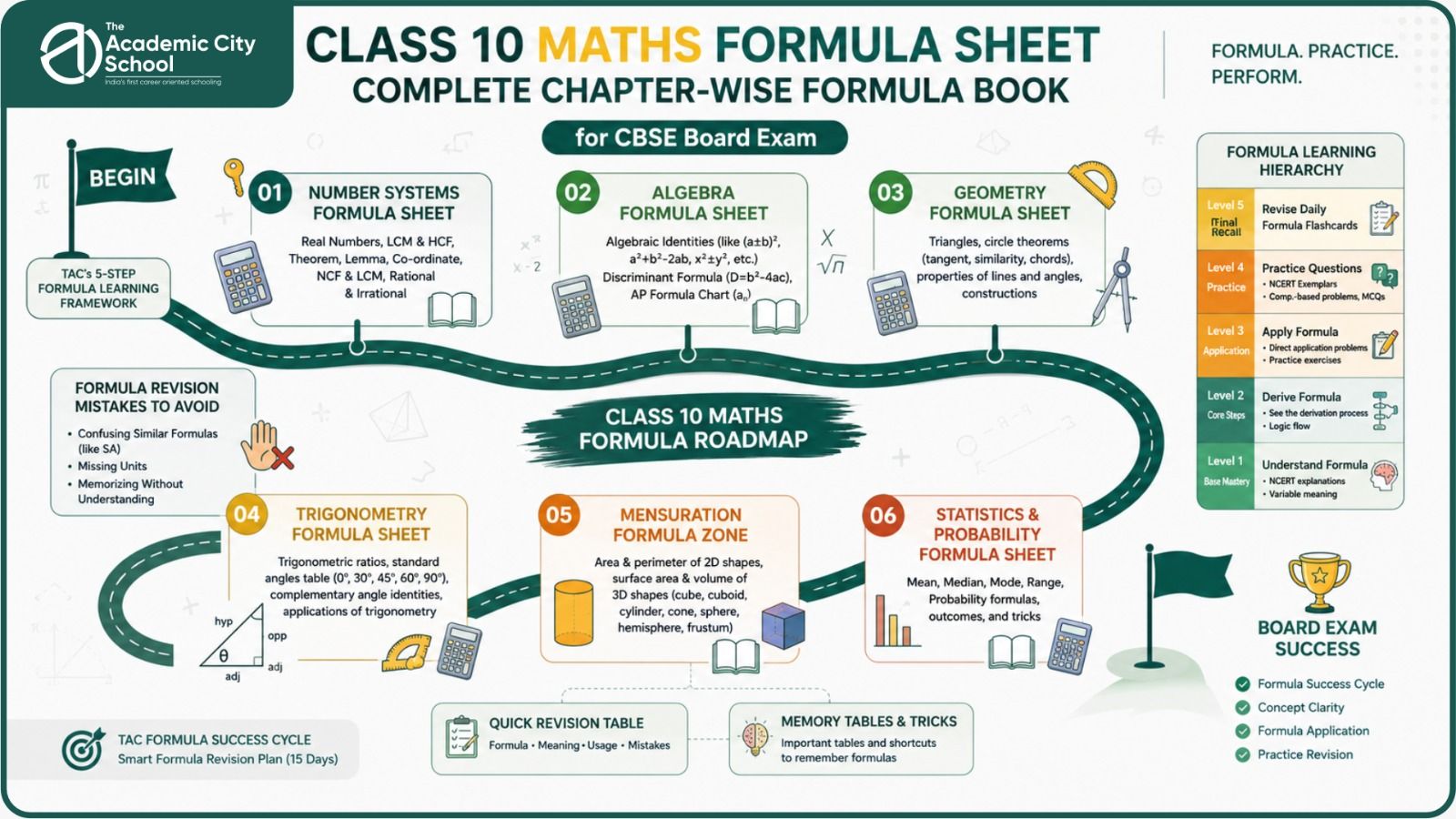 Figure 2: Formula learning hierarchy
Formula Retention Pyramid
Think of formula learning a bit like climbing a small staircase, not a lift you can just jump into. You start at the bottom: understand the formula. Then you climb, derive it, apply it, practise plenty of questions on it, and revise it daily. Skip a step, any step really, and the whole structure gets a bit wobbly closer to exam day.
- Step 1: Understand the formula
- Step 2: Derive the formula
- Step 3: Apply the formula
- Step 4: Practice questions
- Step 5: Revise daily
TAC's 5-Step Formula Learning Framework
At The Academic City School, we do not just hand a formula sheet to students and wish them luck (though we do wish them luck, plenty of it). We walk them through a five-step framework that turns memorising into genuine understanding, and understanding, frankly, is the only kind of learning that survives exam-day nerves.
| Step | What Happens |
|---|---|
| Step 1 | Understand the concept behind the formula |
| Step 2 | Know the formula derivation, not just the final line you copy down |
| Step 3 | Practice NCERT questions using the formula in context |
| Step 4 | Solve MCQs and competency-based questions |
| Step 5 | Daily formula revision, little and often, never one giant cram session |
TAC Formula Success Cycle
Concept leads to formula, formula leads to application, application leads to practice, and practice loops right back into revision. It genuinely is a loop, not a straight line from point A to point B. Students who treat it like a loop, going round and round rather than ticking it off once, tend to hold onto formulas well past the exam date, sometimes for years.
Chapter-Wise Formula Sheet Directory
Every chapter below follows roughly the same layout. Key formulas first, written out clearly. Then identities and theorems where relevant. Short notes, a memory trick or two, and the common mistakes students tend to make. Once you get used to how one chapter is laid out, the rest should feel familiar.
- Key formulas for the chapter, written in full
- Important identities
- Theorems where applicable
- Short revision notes
- Memory tricks that actually help, not just gimmicks
- NCERT-based examples
- Formula applications in real exam-style questions
- Common errors students tend to make
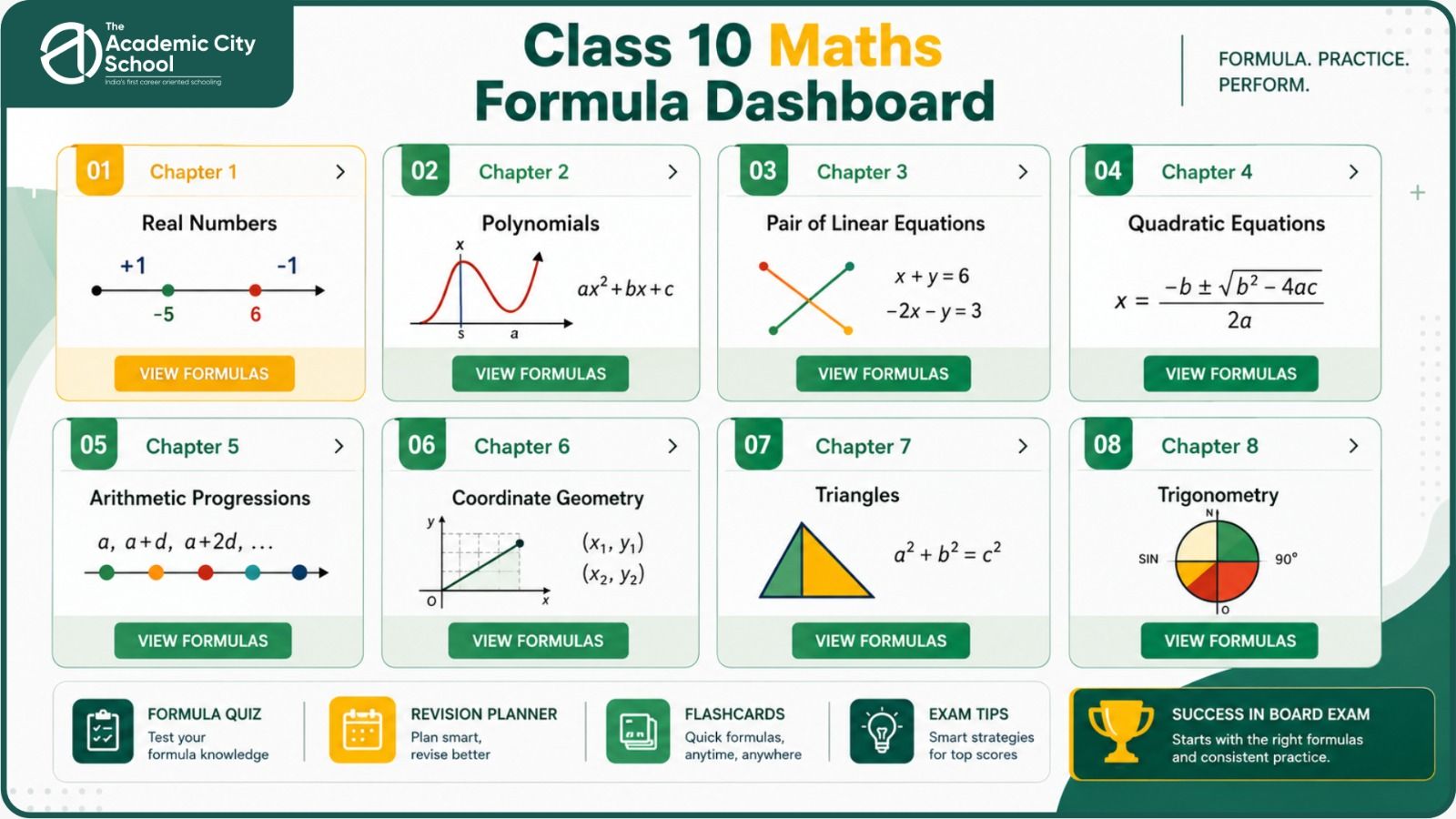 Figure 3: Interactive chapter-wise formula index
Number Systems Formula Sheet
Number Systems might feel like the quieter chapter of Class 10 Maths, the one nobody talks about much. But it quietly sets up a chunk of the logic you will use later in Algebra, so do not skim past it.
Covers
- Euclid's Division Lemma
- Fundamental Theorem of Arithmetic
- Decimal expansion rules
- Rational and irrational numbers
| Formula / Concept | Details |
|---|---|
| Euclid's Division Lemma | a = bq + r, where 0 ≤ r < b |
| HCF and LCM relation | HCF × LCM = Product of the two numbers |
| Fundamental Theorem of Arithmetic | Every composite number = product of primes, uniquely (order aside) |
| Terminating decimal condition | Denominator in form 2ᵐ × 5ⁿ (only powers of 2 and 5) |
| Non-terminating repeating decimal | Denominator has prime factors other than 2 or 5 |
Includes
- Important properties worth memorising, especially the HCF-LCM relation
- Board-level questions for practice
- Quick revision notes for last-minute recall
Algebra Formula Sheet
Algebra carries a hefty chunk of marks in the Class 10 Maths paper. If there is one section worth knowing cold, backwards even, it is this one.
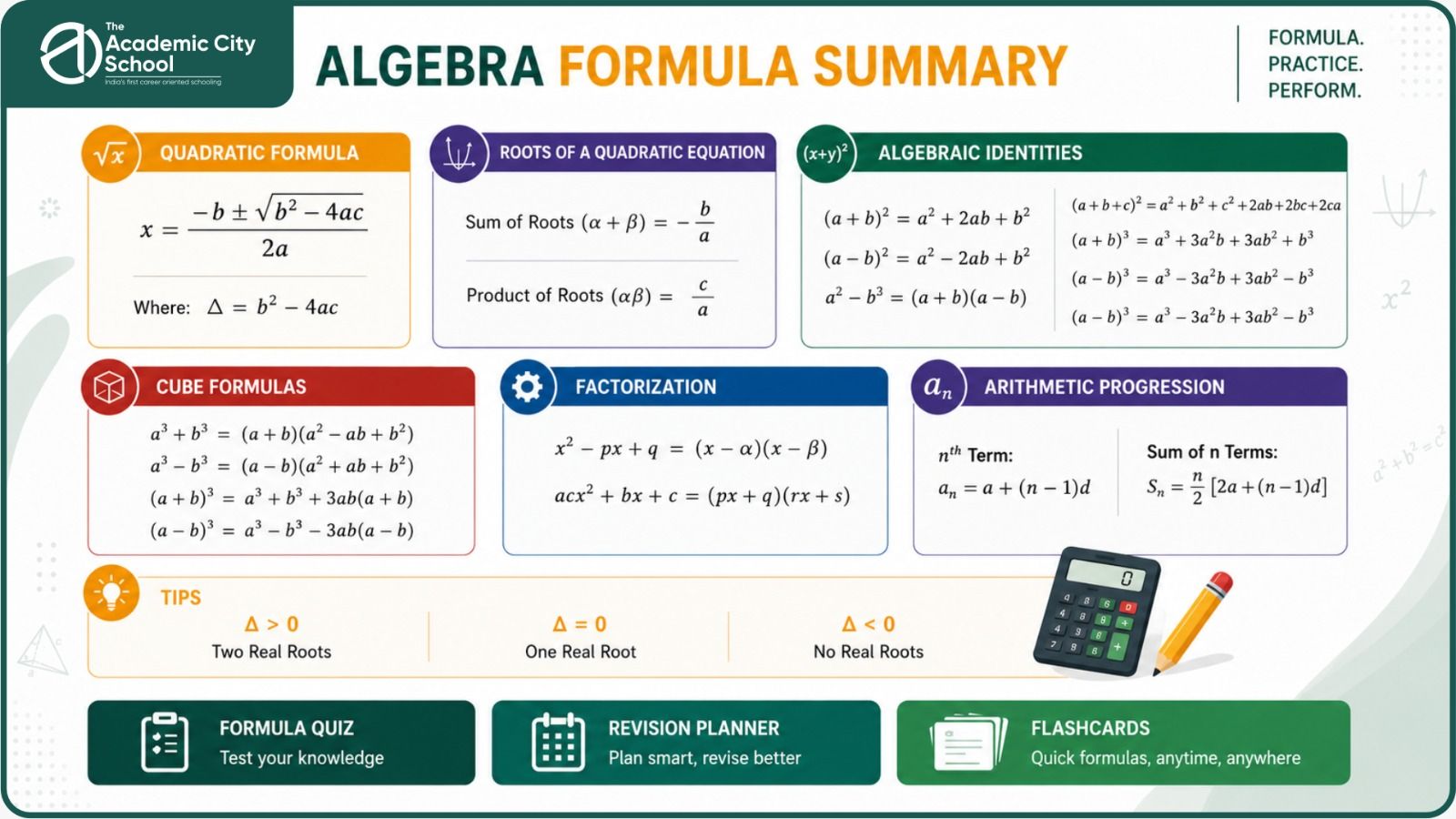 Figure 4: Algebra formulas and identities
| Chapter | Formula Coverage |
|---|---|
| Polynomials | Relationships and identities between zeroes and coefficients |
| Pair of Linear Equations | Elimination and substitution methods |
| Quadratic Equations | Quadratic formula, nature of roots |
| Arithmetic Progressions | nth term and sum formulas |
Polynomials
| Polynomial Formula / Property | Value |
|---|---|
| Quadratic polynomial | ax² + bx + c, a ≠ 0 |
| Sum of zeroes (α + β) | -b / a |
| Product of zeroes (αβ) | c / a |
| Cubic polynomial | ax³ + bx² + cx + d |
| Sum of zeroes | -b / a |
| Sum of product of zeroes taken two at a time | c / a |
| Product of zeroes | -d / a |
Pair of Linear Equations in Two Variables For two equations a₁x + b₁y + c₁ = 0 and a₂x + b₂y + c₂ = 0, the ratios of coefficients tell you everything about the type of solution, almost like a fingerprint.
| Condition | Relationship |
|---|---|
| Unique solution (intersecting lines) | a₁/a₂ ≠ b₁/b₂ |
| No solution (parallel lines) | a₁/a₂ = b₁/b₂ ≠ c₁/c₂ |
| Infinite solutions (coincident lines) | a₁/a₂ = b₁/b₂ = c₁/c₂ |
Quadratic Equations
| Quadratic Formula / Condition | Value |
|---|---|
| Standard form | ax² + bx + c = 0, a ≠ 0 |
| Quadratic formula | x = [-b ± √(b² - 4ac)] / 2a |
| Discriminant (D) | D = b² - 4ac |
| Real and distinct roots | D > 0 |
| Real and equal roots | D = 0 |
| No real roots | D < 0 |
Arithmetic Progressions (AP)
| AP Formula | Expression |
|---|---|
| nth term | aₙ = a + (n - 1)d |
| Sum of first n terms | Sₙ = n/2 [2a + (n - 1)d] |
| Sum (using last term) | Sₙ = n/2 (a + l) |
Formula Highlights
- Algebraic identities used across polynomials and equations, revise (a+b)², (a-b)², and a²-b² too
- The discriminant formula, and what its sign quietly tells you about the roots
- A quick AP formula chart covering the nth term and sum of n terms
Coordinate Geometry Formula Sheet
This chapter is short, genuinely one of the shortest in the book, but do not underestimate it. Coordinate Geometry questions are usually quick, easy marks the moment the right formula clicks into place.
| Coordinate Geometry Formula | Expression |
|---|---|
| Distance formula | d = √[(x₂-x₁)² + (y₂-y₁)²] |
| Section formula | (x, y) = [(mx₂+nx₁)/(m+n), (my₂+ny₁)/(m+n)] |
| Midpoint formula | (x, y) = [(x₁+x₂)/2, (y₁+y₂)/2] |
| Area of a triangle | Area = ½ |x₁(y₂-y₃) + x₂(y₃-y₁) + x₃(y₁-y₂)| |
Includes
- Distance formula between two points
- Section formula, where applicable to the curriculum
- Coordinate relationships used in graph-based problems
- Graph interpretation tips
Practice Focus
- Graph-based questions
- Coordinate calculations
- Board-level applications combining both
Geometry Formula Sheet
Geometry rewards students who actually draw the figure instead of trying to picture it in their head and hoping for the best. Half the battle here, honestly, is just seeing the shape clearly on paper.
Covers
- Triangles and their properties
- Similarity of triangles
- Circle theorems
- Tangents to a circle
- Constructions
| Geometry Theorem / Formula | Statement |
|---|---|
| Pythagoras Theorem | (Hypotenuse)² = (Base)² + (Perpendicular)² |
| Basic Proportionality Theorem (Thales) | If DE ∥ BC, then AD/DB = AE/EC |
| Areas of similar triangles | Ratio of areas = (Ratio of corresponding sides)² |
| Tangent property | A tangent to a circle is perpendicular to the radius at the point of contact |
| Length of tangents | Tangents drawn from an external point are equal in length |
Geometry Revision Tips
- Learn theorems in your own words, not just word for word by rote
- Draw diagrams for every question, even the ones that look deceptively easy
- Apply proof logic step by step instead of jumping straight to the answer
Trigonometry Formula Sheet
If there is one chapter where a formula sheet genuinely saves the day, it is this one, no contest. Trigonometry packs in a lot of small values and identities that blur together fast under exam pressure.
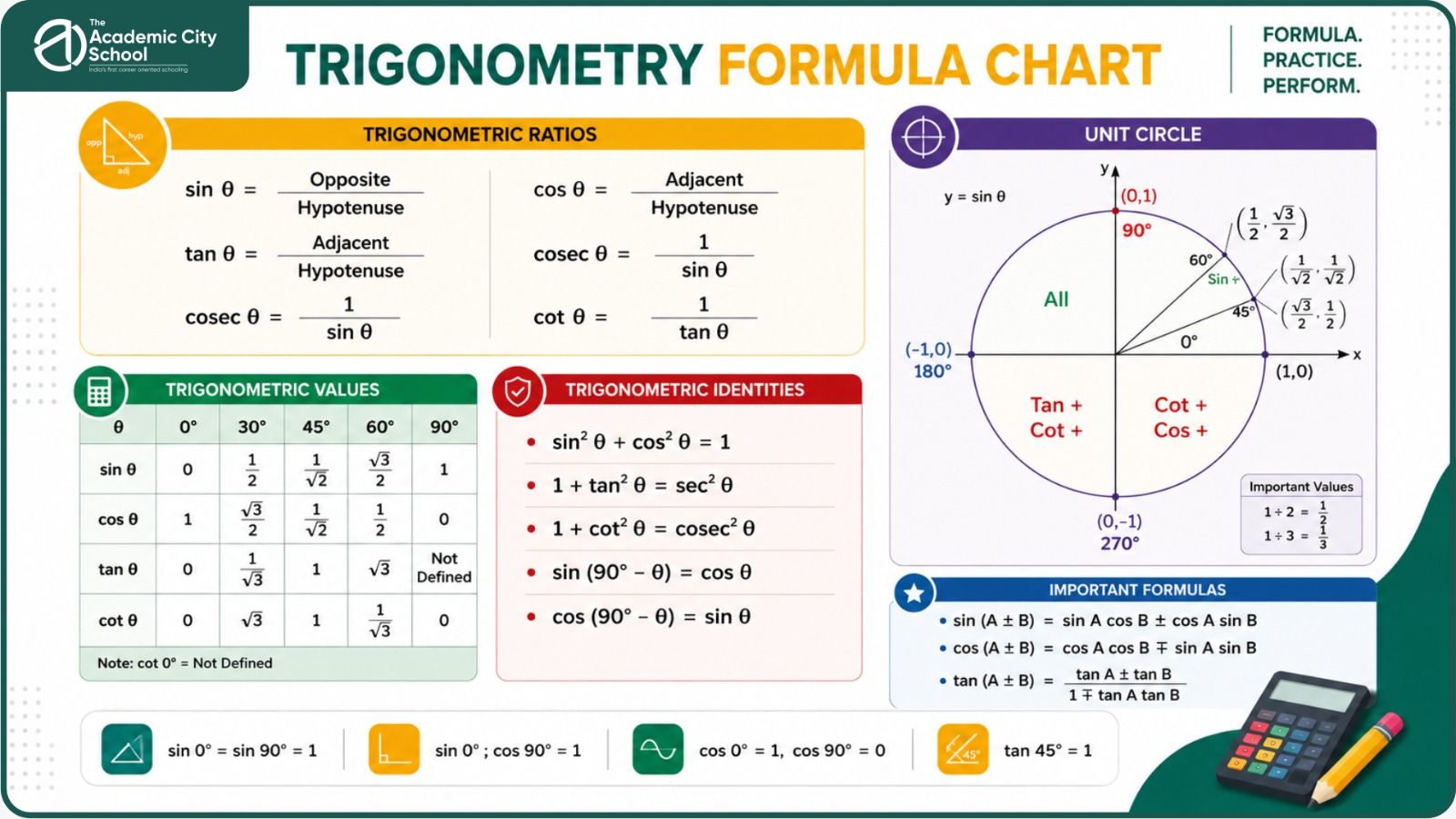 Figure 5: Standard trigonometric values and identities
Formula Collection
- Trigonometric ratios: sine, cosine, tangent, and their reciprocals
- Standard angle values
- Complementary angle identities
- Applications of trigonometry in height and distance problems
| Trigonometric Ratio | Formula |
|---|---|
| sin θ | Opposite / Hypotenuse |
| cos θ | Adjacent / Hypotenuse |
| tan θ | Opposite / Adjacent (also = sin θ / cos θ) |
| cosec θ | 1 / sin θ |
| sec θ | 1 / cos θ |
| cot θ | 1 / tan θ |
| Identity | Formula |
|---|---|
| Identity 1 | sin²θ + cos²θ = 1 |
| Identity 2 | 1 + tan²θ = sec²θ |
| Identity 3 | 1 + cot²θ = cosec²θ |
| Complementary Angle Relation | Equivalent |
|---|---|
| sin (90° - θ) | cos θ |
| cos (90° - θ) | sin θ |
| tan (90° - θ) | cot θ |
| cot (90° - θ) | tan θ |
| sec (90° - θ) | cosec θ |
| cosec (90° - θ) | sec θ |
Memory Table: Standard Angles
| Ratio | 0° | 30° | 45° | 60° | 90° |
|---|---|---|---|---|---|
| sin | 0 | 1/2 | 1/√2 | √3/2 | 1 |
| cos | 1 | √3/2 | 1/√2 | 1/2 | 0 |
| tan | 0 | 1/√3 | 1 | √3 | Not defined |
A little tip that has helped generations of TAC students: write 0, 1, 2, 3, 4 in a row, divide each by 4, then take the square root. That row becomes your sine values from 0° to 90°. Flip the row backwards, and you get cosine. It sounds like a trick, but it works, and it works fast.
Mensuration Formula Sheet
Mensuration is where formulas do practically all the heavy lifting. Get the formula right, and the rest of the question is usually just careful, patient arithmetic.
Includes
- Areas related to circles
- Surface area formulas for solids
- Volume formulas for solids
- Unit conversion chart, since exams do love mixing units on you
| Circle Formula | Expression |
|---|---|
| Area of a circle | πr² |
| Circumference of a circle | 2πr |
| Area of a sector | (θ/360) × πr² |
| Length of an arc | (θ/360) × 2πr |
| Area of a segment | Area of sector − Area of triangle |
| Cylinder Formula | Expression |
|---|---|
| Curved Surface Area (CSA) | 2πrh |
| Total Surface Area (TSA) | 2πr(r + h) |
| Volume | πr²h |
| Cone Formula | Expression |
|---|---|
| Slant height (l) | √(r² + h²) |
| Curved Surface Area (CSA) | πrl |
| Total Surface Area (TSA) | πr(r + l) |
| Volume | (1/3)πr²h |
| Sphere / Hemisphere Formula | Expression |
|---|---|
| Surface Area of a sphere | 4πr² |
| Volume of a sphere | (4/3)πr³ |
| Curved Surface Area of hemisphere | 2πr² |
| Total Surface Area of hemisphere | 3πr² |
| Volume of hemisphere | (2/3)πr³ |
Visual Formula Guide
- Cylinder
- Cone
- Sphere
- Hemisphere
- Frustum, where applicable to your syllabus
Statistics & Probability Formula Sheet
Statistics and Probability tend to be some of the most scoring chapters on the whole paper, mostly because the formulas barely change from one question to the next once you have them down.
Statistics
- Mean
- Median
- Mode
- Cumulative frequency
| Measure | Formula |
|---|---|
| Mean (direct method) | Mean = Σfx / Σf |
| Mean (assumed mean method) | Mean = a + (Σfd / Σf) |
| Mode | Mode = l + [(f₁ - f₀) / (2f₁ - f₀ - f₂)] × h |
| Median | Median = l + [(n/2 - cf) / f] × h |
Probability
- Basic probability formula
- Complementary events
- Outcome counting
| Probability Concept | Formula |
|---|---|
| Probability of an event | P(E) = Number of favourable outcomes / Total number of outcomes |
| Complementary event rule | P(E) + P (not E) = 1 |
| Range of probability | 0 ≤ P(E) ≤ 1 |
Quick Revision Table
| Formula | Meaning | Usage | Common Mistakes |
|---|---|---|---|
| Mean | Average of all values | Data sets, frequency tables | Forgetting to divide by total frequency |
| Mode | Most frequently occurring value | Grouped frequency distributions | Mixing up f₁, f₀, and f₂ in the formula |
| Median | Middle value of ordered data | Grouped data, cumulative frequency | Using the wrong cumulative frequency (cf) |
| Probability | Favourable outcomes over total outcomes | Chance-based questions | Miscounting total possible outcomes |
Formula-Based Important Questions & MCQs
Knowing a formula and knowing exactly when to reach for it are two different skills, and board papers test both, often in the same question.
- Chapter-wise MCQs for quick daily practice
- Formula-based questions across all chapters
- Assertion-reason questions that test conceptual clarity, not just recall
- Competency-based questions modelled on recent CBSE patterns
- Case studies combining two or three formulas at once
- Previous year formula questions, sorted chapter-wise for focused practice
TAC Insight: Many board exam questions test correct formula selection before calculation even begins. Half the lost marks usually trace back to picking the wrong formula, not to a mistake in the maths itself.
Formula Revision Mistakes to Avoid
We have seen the same handful of mistakes repeat, year after year, across hundreds and hundreds of answer sheets. Most of them, honestly, are completely avoidable once you know what to look out for.
Common Errors
- Confusing similar-looking formulas from different chapters, sector area and segment area trip up a lot of students
- Missing units in the final answer, cm² versus cm³ matters more than students think
- Incorrect formula selection for the question type
- Sign errors, especially in algebra and coordinate geometry
- Simple calculation mistakes that creep in under time pressure
- Memorising formulas without understanding what they actually represent
Faculty Observation: Students often lose marks by applying the correct method with the wrong formula, or by overlooking units and signs in the final step. It is rarely the maths itself that fails; it is the small details sitting quietly around it.
Smart Formula Revision Plan (15 Days)
Fifteen days sounds tight, we know. But it is genuinely enough time, provided you follow a plan instead of bouncing randomly between chapters depending on your mood that day.
| Days | Focus Area |
|---|---|
| Days 1-3 | Number Systems and Algebra |
| Days 4-6 | Coordinate Geometry and Geometry |
| Days 7-10 | Trigonometry |
| Days 11-13 | Mensuration |
| Days 14-15 | Statistics, Probability, and full formula revision |
Why Students Choose The Academic City School
Formula sheets help, no doubt about that, but they work best inside a system that actually teaches students how to think through a maths problem, not just memorise the last line of a formula and hope for the best.
What Makes TAC Different
- CBSE-aligned Mathematics learning designed around the current syllabus, updated as the board updates it
- Smart classrooms that make abstract formulas easier to visualise and actually see in action
- A formula-based revision system built into regular teaching, not left for exam week
- Personalised academic support for students who need extra formula practice
- Regular practice tests that mirror the board exam pattern closely
- Board-oriented preparation from an early stage, not a last-minute scramble
Student Outcomes
- Faster formula recall during exams
- Improved accuracy across chapters
- Better board scores, year on year
- Stronger conceptual understanding, not just memorisation
- Effective time management during the paper
- Higher exam confidence walking into the exam hall
Formulas are just tools at the end of the day, nothing more mystical than that. What matters is knowing which one to reach for, and when, and that kind of instinct comes from steady, patient practice, not a last-minute scramble the night before. We hope this Class 10 Maths Formula Sheet gives you a clear, chapter-wise, formula-by-formula starting point for your board exam revision in 2026. Good luck. You have got this.
Frequently Asked Questions
Is the Class 10 Maths Formula Sheet enough for board exams?
It is a strong revision tool, genuinely one of the best shortcuts available, but it works best alongside regular NCERT practice. Formulas get you started; solving actual questions is what gets you the marks.
Which formulas are most frequently asked in CBSE Class 10 Maths?
Trigonometric ratios, the quadratic formula, mensuration formulas for cylinders and cones, and the distance formula show up most consistently across recent board papers.
How can I memorise Maths formulas quickly?
Group them by chapter, write them out by hand a few times (typing them does not seem to work quite the same way), and revise in short daily bursts rather than one long, exhausting session right before the exam.
Should I learn formula derivations?
Yes, even a rough, half-remembered understanding of where a formula comes from makes it far easier to recall under pressure. It also helps enormously with the trickier application-based questions.
Are NCERT formulas sufficient for board exams?
NCERT covers everything the syllabus requires, no gaps there. This formula sheet simply organises those same formulas in a way that is quicker and easier to revise from.
How often should I revise formulas?
A short daily revision, even just ten to fifteen minutes, works far better than cramming everything into one sitting closer to the exam. Little and often wins here, almost every time.
Can I download a printable Class 10 Maths Formula PDF?
Yes, a printable version is included in the free downloadable resources section above.
Which chapters contain the maximum formulas?
Trigonometry, Mensuration, and Algebra tend to carry the highest formula count between them, so it helps to start your revision with these three chapters first.